
→ Tired of throwing spaghetti at the wall with your marketing? In Expand, we’ll create your custom strategy FOR you and execute it WITH you. Plus you’ll get FREE access to Emily’s exclusive live 4-week Business Incubator when you sign up by July 31st: get.embodiedmarketing.com/expand
Scaling a multi-million dollar company isn’t just about finding the right strategies—it’s about finding the right people and creating an environment where they can grow into their full potential.
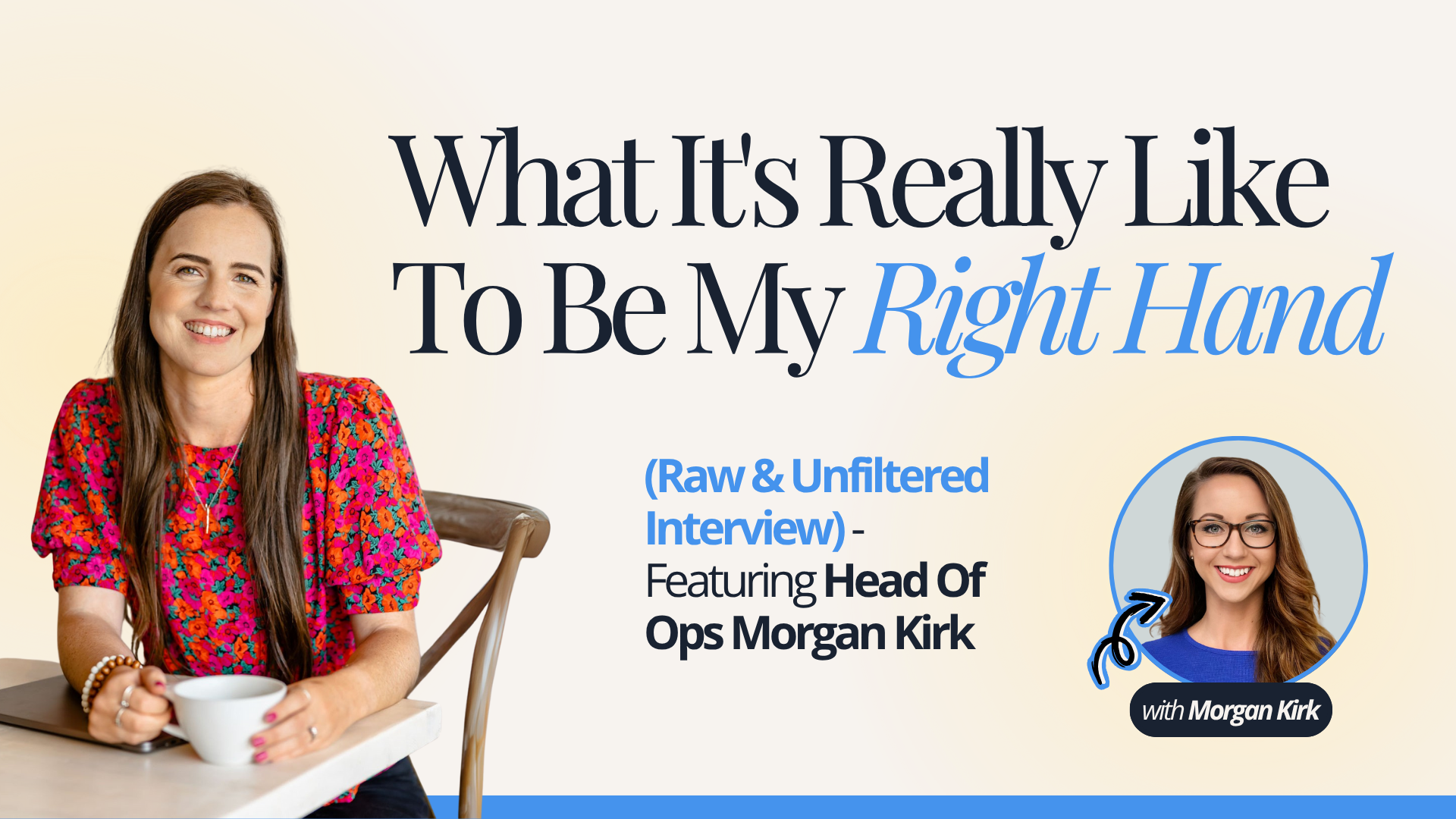
In this episode, I’m sitting down with Morgan Kirk, my right hand and Director of Operations, for a behind-the-scenes conversation about what a high-level CEO-operator relationship really looks like. From her journey as a fifth-grade teacher to running operations for our entire company, Morgan shares the honest truth about growth, leadership, and what keeps exceptional team members thriving for years.
If you’ve ever wondered how to find, develop, and retain top talent—or if you’re curious about what happens behind the scenes of a 7-figure business—this conversation will give you insights you won’t find anywhere else.
Key Takeaways:
- What keeps exceptional people long-term—the specific elements that create loyalty and growth in high-level team relationships
- Success patterns in our programs—what Morgan sees consistently in entrepreneurs who get results versus those who struggle (and it’s simpler than you think)
- How to scale without being the bottleneck—the behind-the-scenes systems that allow our programs to run with 90%+ retention rates while I focus on CEO-level activities
_____________________________________
More ways Embodied Marketing can support you:
If you’re ready to hand off your entire marketing strategy (from funnels to ads to copy) and finally get the expert team you can trust, apply here and let’s talk: helpmystrategy.com
WANT TO WORK WITH TEAM EMBODIED MARKETING?
Honestly, we’re more than a marketing team — we’re a tactical partner who will care about your business growth just as much as YOU (maybe even more)!
We’re here to play the long game and help you create a powerful impact!
SUBSCRIBE & REVIEW THE PODCAST!
Thanks for tuning into this week’s episode of the Embodied Podcast! If this podcast has added value and helped you in your business journey, please head over to Apple Podcast, subscribe to the show, and leave us an honest review.
Your reviews and feedback will not only help us continue to deliver great, helpful content, but it will also help us reach even more amazing entrepreneurs just like you.
READ THE EPISODE TRANSCRIPT
Emily Hirsh: I am beyond excited to welcome Morgan Kirk to the podcast. Morgan is my right hand.
Morgan Kirk: I love being able to accomplish stuff before you come and say, Hey, this would be really cool. I can be like, I already did that. I think that as a CEO, you should have people in your company, especially the people in leadership who think differently than you and have different viewpoints.
We really went deep into our relationship as
Emily Hirsh: CEO, and she’s the operator of the company.
Morgan Kirk: At the end of the day, it’s who you are as a person. That’s how you’re gonna show up at work. That’s how you’re gonna show up as a mom. That’s how you’re gonna show up in your friendships and relationships and all of those things.
Emily Hirsh: I don’t say it enough, but I couldn’t do this without you. I wish for every entrepreneur to have a you. We may have both pride in the episode. It’s incredible and I can’t wait for you to tune in. Embodied CEOs don’t chase trends. They pave the way they lead from within. Move by purpose, unshaken by noise.
When you are the source, you do not need permission. Morgan, Kirk, you’re back on the podcast. Yeah. Round two in person. I guess we were in person last time. We were in person, but not at the studio. Yeah. Welcome back. Thank you. So Morgan is my right hand in the business. She does many things. I got your titles, director of operations, right?
Sure, yeah. It’s, it’s my right hand in many ways. Primarily in charge of our Done with You program and our hiring and sales and a lot of things in the company. So, a lot of things. Yeah. Let’s I wanna start with a little more of you. I, I feel like last time we talked a lot, we did like questions last time.
Yeah. Not really a conversation. So let’s start with you and your story. Okay.
Morgan Kirk: Well I guess we could start with where I thought I would be now, or maybe where I, we’ll start with college. That’ll be good. So I went to a super small college in Arlington, Texas. I originally thought that I was gonna be a therapist, which is funny in so many ways actually now looking back.
But I wanted to help people. So I went to college. I got a four year degree in psychology and with full intentions of you know, being a therapist, have my own practice one day. But I got married super, super young and had a baby super young just like you. And so I had my daughter when I was 21 and I wanted to, I dunno, do something different. I with kids, I thought that that would be a lot of fun. So I love kids. I have 13 siblings, so I’ve always loved kids. And so I decided I was gonna be a teacher instead. So instead of a therapist, which I think that, that probably those things kind of flow together. So I started teaching and I taught elementary school, which I loved.
I love kids. I think they’re incredible. They’re brilliant. They teach you so many things. And so I think it shaped a lot of who I kind of was and am. But I had another child and I realized that I was kind of sending them to a teacher all day. And I was obviously enjoying teaching kids, but I was missing out on a lot of what they did.
So when my kids were, well, it’s been a while now, but they, I just decided that I wanted to look for something else to do. And maybe work remotely. And so I went on Indeed and applied for lots of jobs. I think I’ve shared this on the last time that we were on the podcast, but I applied for lots of jobs.
I thought I could potentially do things that were like operations or it’s like spreadsheets, stuff that I really felt like I could, could do. And I applied for a role that you had as an operations assistant for a program market like a pro. And had a really great interview and was able to share a little bit about what I thought I could do.
I maybe embellished things that I could do so that way I could get the job and I did. And so yeah, that’s how I ended up working for you at. What was Hirsch marketing and being able to spend a little bit more time with my kids, which was, was my goal, was have more time with them and not miss out on everything that I was missing out on while I was teaching.
‘Cause it takes up not just your whole day at school, but then your whole day afterwards. There’s like so much that goes into it. So was once a fifth grade teacher and now run operations, run the company basically.
Emily Hirsh: Yes. What do you, what do you love doing? Like what is your, when you think about your days right now, like what is your favorite?
Morgan Kirk: I think there’s two things. I love background stuff. I love being able to accomplish stuff before you come and say, Hey, this would be really cool. I can be like, I already did that, or here’s this. Or be able to just like. Make things easier for other people. I think that’s something I’ve always loved doing.
It’s something I love doing at home in my personal life with friends. I like to just have a plan and have things done. So I like that. I also found that I really enjoy seeing other people accomplish dreams, goals, things that they’ve set out for themselves, and I think that’s twofold. At our company one, you, I love seeing that, the things that you’re like, oh, I have this idea and let’s, you know, orchestrate it.
And so we can do like the stuff behind the scenes and then you, I don’t know, you like come up with an idea and then we like launched it two weeks later or five days later or whatever the case is. So I love that. I love being able to be that kind of behind the scenes support for you and see all of that you get to accomplish.
So that, and then also in our Done with You program. I think that’s something that I didn’t know I would really enjoy. I never even imagined myself running that program. But seeing people come in with this idea or this passion that they have and then see that come to fruition, I think is, is beautiful.
And getting to meet those people sometimes in person, like at our live events is really awesome. I think that I’ve met more people with big goals that accomplish those goals working here than I ever have anywhere else. I think you meet a lot of people who say a lot of things and they’re like, this is what I wanna do one day, or This is what I would love to do.
And in our done with You program and expand and in all areas of the company, we just meet people who are like, this is what I wanna do, and then they do it and it’s really cool. Or they have like huge epiphanies while they’re with us and say, well, this is what I thought I loved. This is what I actually love.
And then I’ll like completely change course and do something. And you get to see that just breakthroughs and huge accomplishments. And of course sales and all of that is important too, but it’s, it’s that like, this, like life them embracing what they love is really cool. And that in turn, I think causes a lot of reflection for me and growth for me too because, you know, I think we all wanna do what we love.
And so it’s cool to see people do that all the time.
Emily Hirsh: I love that. I remember the first mastermind, so Morgan comes to most of my retreats. Yeah. And is a support. And the first mastermind you were like, I don’t think I’ve ever been around so many people who have these like huge. Visions and goals. Yeah.
And then
Morgan Kirk: just talk, like they’re gonna just go do it. Yeah. I’ve, I’ve never been around people like that until this powerful, incredible just people who are like, this is, this is what I wanna do, and then they do it or they talk like they’ve done it already, which I think is powerful in itself. It’s just such a huge, like, mindset shift or just a, a mindset thing in general that is different from how I was raised or, you know, I think the way I was raised was really like, this is kinda how you do life and this is, you have little goals.
Your goals are little small. And so especially just the, I think just the culture that I was raised in. And so you have these little goals and everyone’s goals are typically the same. I went to college with people. Everyone’s goal was exactly the same. And so to be around oftentimes women who are just so.
I don’t know. They’re so confident and powerful and even if they’re not like, I dunno, it’s so, it’s the presence that they give off and the, the ability to just do things I think is so, so cool. You know, I think at the end of the day I’m like, man, I could really do anything
Emily Hirsh: Exactly know. That’s really cool.
Morgan Kirk: You know, I think I spent so much of my life being like I look at other people’s goals and dreams. Like, that’s so cool that they did that and not have that like for myself. And so I think just being around the people that you surround yourself with and that you have an impact on has really shown me, like, and I could really just do, if I wanted to do this tomorrow, I could do that.
I just have to say it and put in the work. I think that’s really awesome. This is the people that you’re around all the
Emily Hirsh: time. That’s so cool. What, what kind of impact has that had? Like if you look back, how long have you been here? Three years. Three years. More than three years. More than three years, yeah.
When you look at who you were three years ago to today and like being around that. Yeah. Because it’s really perspective, right? Absolutely. It’s showing you like a whole different way of looking at the world.
Morgan Kirk: Absolutely. Well, I think, oh gosh, I, we could talk for hours on that. I don’t think there would be enough time, but I think there’s a couple of things.
One, I think when I first came into Embodied Marketing, I was definitely not a confident person. I think it’s something I probably still struggle with, but I was like only wanting to be behind the scenes, only wanting to do stuff where like no one had to talk to me directly. I could just make things work and that would be fine.
I think that being around people, being around you and then being around the people that you are surrounded by has really just made me just a more confident person. Like, you know, I can, I think a big shift for me was being at the live event in January and having these business owners who are. So incredible.
Come to me and ask me for advice or ask me for things. I’m like, oh, you like see me as a, as a person who has like value and thoughts and things to add. And that was so cool for me. So that’s, that’s one way I think that it’s shifted is like, wow, I really do have a lot to bring. So that’s one. And then I also, I think that and, and I’ve been able to be more outspoken and like lead things.
And then two, we’ll just continue with that, which is like leadership. I think I’ve always kind of just viewed myself as somebody who would like, clock in and clock out. Whether that was in a previous life or whether that was, you know, here. And I think that I’ve realized that I have a lot more. Like leadership skills.
I just needed somebody and circumstances and people who believe in you to kind of like bring that out. So that, and then I, there’s a lot I just think the way that I view the world too, you know, I think I kind of came from you know, and I alluded to this earlier, but I just came from an environment where, again, things are really small and you have a very small picture of the world.
And not that I didn’t know that the world is vast and big and full of all of these wonderful things, but I just was very, I, I just lived in that small world and so to meet so many incredible people and to have like the, the conversations that we have and like the growth opportunities and things, I’ve been able to see that there’s, there’s, there’s a, a really great big world where there are.
So many things I’ve never heard of. So many things I’ve never experienced. And just opportunities I think is, is a, is a big one. Yeah. Totally different
Emily Hirsh: perspective. Yeah. And view
Morgan Kirk: the perspective that I, that I had again, I think was small. That’s the best way to describe it. I like this small worldview.
And so again, to just be able to be in a room with people who have all these different, it’s like they just say it and then things happen for them. And they, I think that’s, it’s just, it’s a really cool thing to be around and it’s a really cool way to it’s a really cool thing to have your life impacted by and, and, and changed.
Emily Hirsh: So I love it. So I think that people would be curious because a lot of people listening is entrepreneurs who hire a team. Yeah. I would love to hear from your perspective as a right hand, there’s many people I know who are like, they would kill to have a you in their business. What is it that you appreciate in the leader, like that keeps you here?
Yeah. If someone’s like, I wanna have a right hand, I don’t think we’ll go into how to find them because that’s very tactical.
Morgan Kirk: Sure.
Emily Hirsh: But how to really like, create that role and have them thrive. Like what are things that we do? And obviously I’m not perfect. We can talk about those things that I don’t do perfectly and we probably will, but what are the things that kept
Morgan Kirk: kept you here for over three years?
Yeah, absolutely. I think the, the, the biggest thing is well I think there’s a lot of big things actually. So I think that, having growth opportunities is really important. So having those conversations of, this is where you are now, but where do you see yourself? Where would you, what would you like to do?
How can we use the skillset that you have? What are skills that you wish you had? How can we really support in that? I think those conversations are really important. I think connection is really important. I think the reason that you and I work so well together is that we’ve created, we, I mean, we have a relationship and so, you know, I’ve learned who you are and what you love and what you enjoy.
And then same for me. And so as somebody who is working, you know, directly with you and helping with a lot of stuff behind the scenes knowing you and knowing what you would do in various situations is, is really important. And I think that having that sort of relationship and connection with those people who are doing that is really important.
And then I, I think I. Thrive. And I think a lot of people who are operations like-minded or like behind the scenes, we really thrive in an environment where we feel seen and valued and heard. And I think that in every role I’ve really had before, not really like the outspoken speak up about stuff now, but one thing that you’ve done and done really well is created an environment where I feel completely confident and comfortable in coming to you and saying, this is what I think about this, or this is where I think we’re missing the mark, or this is where I think we could do better or we could change even if our opinions are, are different.
And I think that’s really, really important. I think that you need to have an environment not just with your right hand person, but with anyone that’s in your company that they feel comfortable coming to even the CEO of the company and saying, here’s where I think we could do better. Or here’s where I think that.
We can improve. Or this is something that I love that you do. Let’s do more of that. And I think I, I said this a minute ago, but people want to be heard and seen and valued. And so, you know, the things like, Hey, by the way, you’re doing a great job. Or you know, thank you is is a big one. You know, I think that sometimes we get into like the day-to-day of work and it’s like, check the box, check the box, you know this.
But, but people want to be seen. And I think the people who are gonna be somewhere long-term are those people who feel valued both in the. The, the work that they do and their opinions and thoughts and and also yeah. That they are appreciated.
Emily Hirsh: Yeah. I wanna speak on that a little bit because we, it goes both ways.
Like I also feel that I can challenge you and you’re not gonna quit. Absolutely. Which is, I’m serious because I think there’s been relationships before where I’m like, I’m, I’m not in alignment with that, but I can’t say anything ’cause I’m walking on eggshells with that person and I absolutely can’t lose them right now.
And literally even yesterday sitting in this studio, we had a hard conversation where you were like, challenging me and we, we, that is so critical with especially leadership roles. Mm-hmm. Because I want that like, and I need that. I think a lot of people listening will understand, like, I’m a very strong personality as most entrepreneurs are, and the only way to fully have.
My respect is someone who can come up against that and, and challenge me, and then I’m like, oh, I’m gonna listen. Yeah. And we have these conversations all the time where a lot of, a lot of times, like our, and it’s, it’s complimentary, our viewpoint on team. It’s like CEOs are going to be very budget conscious and bottom line as they should be and, and paying attention to those.
Whereas operations should be the filter a lot of times to the rest of the team, to the culture, to the, the more emotional side of things. Right. And that, that’s very much how we work together, where you can say like, Hey, I get where you’re coming from here, but also we should consider this. And we had that conversation yesterday and I was like, okay, so what, what do you want me to do?
Like, what is your viewpoint? Yeah. And we have that a lot. And I think that’s so valuable for A CEO to have that perspective and have somebody who compliments their quote, weakness. Which is almost a good weakness because the CEO should be focused on the bottom line. That’s their job. So I, I really appreciate that, and I think that’s a very important part to our relationship is it goes both ways that we can challenge each other and have hard conversations.
Absolutely. And like
Morgan Kirk: be fine. I think it’s, I think it’s critical. I think we’ve, we’ve had a conversation before where if you are surrounded only by people who are just like you and your company, then there’s gonna be things that you miss. There’ll be gaps and holes and, you know, you can create big issues.
I think that as a CEO speaking as not a CEO you should have people in your company, especially the people in leadership who think differently than you and have different viewpoints. And same for, for me, like I have been challenged many times by conversations we’ve had. Where I’ve shifted and changed my viewpoints and later on it’s been helpful in bigger situations that have happened because I am more emotionally driven.
And you can’t operate that way all the time. There has to be things that, you know, like factual bottom line, you know, those pieces are really important too. But we also have conversations where it’s like, well, let’s pause for a minute and, and think this through. Because there’s, there’s often more to, more to a picture or more to a, a situation.
And so to have both sides. And I think oftentimes we come to like a middle ground or we’ll end it on say, and just say, well, I don’t agree with you, but then we can still move forward. I think that that actually happened recently too, where I think we ended a conversation where you said, I just don’t agree, and that’s Okay.
That like, it really is okay. And I think that years ago I would’ve been like, oh crap, you know, she doesn’t agree with me. That’s, that’s a big problem. You know, am I in the wrong or I need to fix that? I think the reality is I’m not in the wrong. You’re not in the wrong either. We don’t always have to agree, but I think it’s so important to be challenged so that your company and, you know, all of the byproducts of that are, are well-rounded and that can’t happen if it’s just you.
It also can’t happen when you are surrounded by people just like you. So I think if you’re like a CEO or you’re someone that’s looking to build your team, I know some are gonna talk about hiring ’cause it’s, you know, it’s, it’s a it’s a very tactical thing, but I do think that you should be looking for somebody that compliments your weaknesses.
And so, you know, if you’re not aware of what those weaknesses are, then I think that would be the place to start. And then find somebody who can support in those areas. As
Emily Hirsh: you grow. Yeah, 100%. And, and there are times, like I know where my line is and there are times that I have, and I think that example that you said, I think I said I don’t agree, but we’ll, okay.
Yeah, you can make the call. Because it wasn’t where I was like, no, this is a hard line that I will not, you know, say yes to. And so I also give, especially my leadership team autonomy to make decisions that, I mean, it’s not like, oh, that’s gonna cost, you know, $10,000 or something type of decision, but it, it was, it probably like a small amount of money and I was like, okay, like I’ll give you the autonomy to make that decision.
I do not agree, here’s why. But I feel comfortable giving you that autonomy and you made the decision.
Morgan Kirk: Yeah. And I, I think that’s huge. One, it’s, it’s huge for me as somebody in a leadership role because one, I know that you respect who I am as a leader and that, you know, go back to the confidence we talked about earlier.
I think that’s, that’s, that’s a big deal. And your leadership team needs to know that you. Trust them and that they can make those decisions. You know, even if you don’t fully agree. And you know, vice versa when you make decisions, you’re like, this is the hard line. This is what we’re doing. Even if I don’t agree, you know, I obviously trust you as a person, like look at what you’ve done.
But I think that’s, that’s really important.
Emily Hirsh: Yeah. As we’re talking, I’m actually realizing how much we do do this. Yeah. Like have these harder conversations. I mean, because when you’re dealing with team, we have 18 people on our team, there’s just a lot always happening. And so there is a lot of these decisions that sometimes have to be made.
And I think that same, we’re talking a lot like this relationship with my leadership team, but it does trickle down in the sense that the people who report to you, I would bet you do a similar thing. They may not have as much freedom to call shots, but I think we have a culture where it’s like. Okay. You don’t agree?
What do you think? Yeah. And and encourage the pushback
Morgan Kirk: Yeah. From
Emily Hirsh: people.
Morgan Kirk: Yeah. In fact, I just had a conversation like that last week with somebody on our team who you know, is a, a situation where maybe we just didn’t, we didn’t agree, but we had to say, what, what do you think? Then? What do you think we should do here?
And it was a really great conversation. And I, I just think that’s important. You know, you can’t operate a company where it’s, here’s what we’re doing and it’s, you know, rigid all the way down. You have a company full of people and people are all different. They bring all sorts of different, you know, skills, assets with them to a company and they also bring who they are as a person.
And so there’s not a hard and fast line everywhere. And so I think that’s really, it’s important conversations to have.
Emily Hirsh: Yeah. And obviously it’s once people earn the trust, but after this long, and as soon as I have someone’s trust, I really wanna give them that autonomy. Yeah. And I’m like, please. Push against me.
And I think I’ve said this, I may have heard this somewhere, but it was like, if there’s a problem and it happens and you come to me and say, I knew that was gonna happen, but you didn’t say anything like, then I’m gonna be mad. Right? But if you, if you push back before and say, I think we should pause, or I think we should consider this, it’s so important to have your, that in your company, whether it’s one person, multiple people, mentors, because we can’t live in our own world of like, this is the truth.
Morgan Kirk: Right?
Emily Hirsh: Right. Yeah, absolutely. So I wanna shift the conversation a little bit because you have an opportunity where you’ve spoken to a lot of business owners. So Morgan oversees at a high level, our entire done with You program, which has got a hundred plus business owners. I mean, we’ve worked with hundreds, hundreds, you know, hundreds that you see on the coaching, you see behind the scenes, like you’ve done calls with, you’ve also stepped in and helped with our sales.
And so you’ve helped at times with sales calls and. Therefore had a lot of conversations with business owners. Yeah. So I’d love to hear from you, like any themes that you see in terms of success versus where
Morgan Kirk: they’re getting stuck so easy. I do talk to lots of business owners. We see lots of them have come through our programs, done for you, done with you.
And I, I always say that the people who are gonna have the most success are the ones who put in the work. I think that’s something, you know, we talk about this, you come up with an idea and it’s like, let’s put boots on the ground and start working. Let’s, let’s get it done. We have. People come into our Done With You program and they have you know, these big dreams and hopes and goals, but that just doesn’t happen overnight.
You have to put in the work. And so the people who have the greatest success are the people who take what we’ve given them and are done with you program. We give them strategy that’s completely custom for them. All of the tools and resources and coaching, the ones who put in the work, who show up, those are the ones who have success.
The people who come and I think they’re kind of hoping for like a magic button, you know, or like this magic thing that’s gonna happen. If I sign up for this program, then I’m gonna have all the success in the world. I don’t think that’s how, like anything works. If it is, let me know where that is, but it’s the people who show up and they put in that hard work.
So that’s the theme that I see consistently with, with those people. In fact, I’ve had people ask me before on sales calls. What do I need to do to be successful in this? Or what do you see? Where do you see people fall off? And I say it’s the people who don’t put in the work, but it’s also the people who don’t show up.
I think being an entrepreneur or being a CEO of a company can be isolating and lonely. You’re by yourself. You’re, you know, trying to play all of the parts, especially in the beginning, in the beginning of a business. And you know this very well. You’re wearing this hat and this hat, and this hat and this hat.
You’re doing all of the things and it can really feel very isolating. And so I think that, you know how being, like showing up for coaching calls or showing up where there are other entrepreneurs makes a huge difference. You’re listening to other people’s ideas, thoughts. They’re reviewing stuff.
They’re giving you feedback. You can take that feedback and implement it. Having connection with other people is huge. You can see we were talking about kind of blind spots earlier. When it comes to your team, the same thing can happen. If it’s your business and you know what you’re trying to implement, you can have blind spots that you don’t see.
You know, you might think you know exactly who your ideal client is because you have all of this information you wanna give them, but you might be missing really critical pieces. And having conversations with coaches or having conversations, even with just other business owners, can shine light on where those gaps are or what you’re missing.
And so the people who do that, put in the work and they show up and they implement, I’m gonna keep adding and they implement the feedback that they’re given. Those are the people that have success. Like, I can literally think of them off the top of my head. If you do that, you’re gonna see all kinds of great results at the end.
Whether that’s with us or whether that’s, I think that’s like a life principle in general, right. If you want something, put in the work. And I think that’s really all there is to it.
Emily Hirsh: It really
Morgan Kirk: is
Emily Hirsh: simple, but yet there are a lot of people who don’t do it.
Morgan Kirk: There are so many people, like we were, we were just having a conversation with some of our team earlier this morning about, it’s so interesting that sometimes people will, again, I think they’re expecting this like magic button and so they’ll sign up for the program and then we never hear from them again.
And it’s like we’re chasing after them. Like, Hey, like we’re here. We wanna help you, we wanna support you. And we don’t hear from them. And so I think that it’s so interesting to me. But I think you can tell who is really all in and who wants it at the end of the day, you know, if you want something, you’re gonna put everything into it.
If you’re not putting everything into it and there’s something else behind the scenes that there’s some, some kind of roadblock, there’s a mental block, there’s something, there’s some reason why you’re not putting everything into it. I think that needs to be solved first. And then you can drop back in and we’ll be there.
We’re gonna be there to help you. So.
Emily Hirsh: Yeah, it’s so, it’s so true. And I think a lot of it’s subconscious. Yeah. People think they want it, they think they’re all in, but their actions don’t always show that. And being able to have awareness to yourself is very important, I think. I think that’s something that I naturally do and I’m really grateful for, is I can be like, all right, you know, like I, I don’t have the ego of like, tell, tell me where my blind spots are.
I actually wanna know. Yeah. Yeah. And the more you can do that and separate your ego from that and your identity from it, and then be like, all right, let’s dig into why I feel like I’m not showing up. Am I not aligned? Do I not actually want this? What is that piece? But it is really simple. It’s like no one’s gonna come save you.
Morgan Kirk: Right?
Emily Hirsh: Like you can buy the, buy the program, hire the coaches, hire the agency, and that’s great. That’s gonna help get you where you wanna go, but no one can actually show up for you. Right.
Morgan Kirk: Right. And you can just keep on, you can keep hiring more, you can keep switching programs and doing something new. But I think there’s, there’s a common theme there.
Yeah. You have to show
Emily Hirsh: up. Our expand program is very successful and we have an incredible retention rate, especially for a program that’s designed to be 90 days. Right. And then you can leave. Yeah. You at the high level oversee that and oversee all of our coaches in the entire operation. So people who have programs, which is everybody who sells an offer on here not everybody has a program, but has a program, has clients.
What do you think is our major? Keys to success that we have in our delivery.
Morgan Kirk: Yeah. I think that there’s kind of two things. One and this is initially and follows through in our delivery, is that what we do is custom. I think that there’s a lot of programs where it’s very cookie cutter.
Everything is, if you do this, then this will be your result. I think we’re, we’re all used to seeing ads like that. Like, in 90 days you’re gonna get X, Y, and Z. Or if you have a coaching business, just take this exact thing and plug it into your business and it’s gonna be great, and you’re gonna see all these results.
And the reality is, is that’s just not true. Every business is different. Every business owner is different. Every ideal client is different, everybody’s business is different. Who is behind it? And so we not only create like custom strategy, which is crucial, but then our actual program itself is customized to each.
Individual business owner and where they’re at and what they need to accomplish while they’re with us. And so I think that that customization is really key. Because I just don’t think in the world of marketing, in the world of advertising and all of those pieces, that you can just have something that’s plug and play.
I think it has to be customized. And so I think that’s, that’s number one. And then two, I think is the intention, the intentionality that we have in the way that we do our coaching the follow up that we have, the way we connect with business owners and the intentionality that we have in, you know, the way we create ads and the way that we deliver our content.
All of that is done in a way that it creates this this journey for business owners or for, you know, people who are, are creating their business. And I think that that intentionality is really important. I think a lot of times people. Are just, I dunno, I think they wanna have a program and they just want it to like, operate in the background and just be like, totally successful.
And I think there’s, there’s probably ones that are, but I think that having the touch points that we have and the intentionality and the way that we deliver our program is really crucial. You don’t join our program and then in 90 days you hear from us like, Hey, you wanna stay? Like, that’s not how it works.
The whole thing is very intentional and we have a lot of touch points with each person. In fact, there’s people who are gonna listen to this, that they’re gonna say, oh, yep. Morgan did reach out to me six times because she hadn’t heard from me. Or, you know our coach reached out because, you know, I wasn’t making progress.
I hadn’t put anything in my workbook, or I hadn’t, you know, watched any of the videos or I hadn’t, you know, come to a coaching call. And so I think that those touch points, and again, that intentionality that we’ve created and the way that we deliver our program. Makes a really big difference. It goes back to what we talked about before about being seen and being heard.
I think that everyone wants that. And so in a program that really is supposed to be a 90 day program people feel seen and heard and they know that we’re 100% supportive of them and we’re there to help them as they get to where they wanna go. And so I think people really enjoy the connection.
Emily Hirsh: Yeah, we really put a lot into the experience. Yeah, absolutely. Experience. It’s not just login and here’s your program and good luck. Yeah. It’s the whole experience in the coaching and Yeah, like you said, the, the accountability that we create with the follow up. Oh, the accountability
Morgan Kirk: is huge. I think that’s.
That’s a big one too. It’s every week we have an accountability call that’s posted where, you know, our members show up and they set goals for the week. And it’s not just they set the goals and they’re like, okay, have like, good luck with those goals. They set the goals and then our coaches follow up with them.
You know, where did you achieve that goal? Where are you at? Where were you stuck? How can I help you move forward? And then we do the exact same thing the following week. And so I think the accountability is, is the accountability is really big. Again, it goes back to, you know, sometimes as a business owner, you have a lot on your plate.
You’re doing a lot of things. And so to have the accountability of, all right, I set these goals for this week and I know someone’s gonna follow up with me, so I gotta put in the work here, I think is, is, is a, a, a key to our program.
Emily Hirsh: So our program runs pretty much without me. I come in and do surprise Q and as sometimes for people.
Somewhat surprised. We just don’t promise them. Yeah. It’s not part of what you buy is not, is actually none of me except for prerecorded content. And I get asked a lot, like how? How have you done that? So I could speak to this, but I’m curious on your point, like how are we so successful in terms of results in our program with me not involved at all on a day-to-day basis.
Morgan Kirk: Yeah. I think that you have created, well our coaches in the program are very like well-trained and have learned from you. So that’s one. I think people will ask me sometimes, well, how am I gonna get results if Emily’s not making my strategy? Well, our strategist knows. All of the things that Emily would suggest, what she would do in various situations you know, with, with different businesses and, you know, different strategies that she would suggest.
And the same with our coaches. So you’re getting Emily without Emily having to be there, you know, they are watching everything that Emily does. They are learning from her. They are, I don’t know why I’m talking about you in third person, but they they come to your webinars. They are on top of all of the things that are shifting and changing in the world of marketing.
And they know, you know, the, the strategies that you have. And I think that’s one of the things you’re really good at, is like listening to somebody’s business and like pinpointing, all right, here’s where the issue is and this is what we need to do. And so our coaches, our strategists, the people on our team, they have learned from that.
And so you’re still getting Emily whether that’s through prerecorded, you know, the, the lessons. But you’re also getting it in the, in the form of coaching, in the form of strategy, even down to like, when I’m interacting with clients or our wonderful operations assistant is interacting with clients.
Like, we all have that same like, just training and we’re watching you and we’re learning from you. And so I think that the reason it’s so successful is because you have created the, the training, the culture, the education, and it’s trickled down into the team. And so and then they bring their own to it as well.
So it’s not just Emily. They’re also bringing their own skill sets, their, you know, what they’ve, what they’re, what they have learned and their own viewpoints into things as well. So I get, you get Emily Plus,
Emily Hirsh: right? Because I don’t manage ads, so if you had me running an ad call, you’d be really in trouble.
Morgan Kirk: Yeah. Yeah.
Emily Hirsh: And I think, I think that it’s a dream for a lot of entrepreneurs to have a program that is running completely without them. I also think they oftentimes can’t see the path to getting there. And I think probably a lot of times it’s subconscious. They have this like no one can do it as good as me.
And that literally no one is special. That special that no one can do what you can do. There’s very few things that no one can do. What I do, sitting right here and recording a podcast is like one of the few. Yeah. Right. My team can do it better than me. And if you have a CEO who’s also being a CEO doing all the marketing, delivering the product, it’s a recipe for a disaster for everybody.
Absolutely. Yeah. So what I’ve done is pull out the process, right? And the experience, like the entire expand program, the milestones I created those, I created the, the experience that people go through, the way that the strategist does it, and then you guys improve it based on the, the feedback. So the foundation was created by me.
Coaches are trained by me. You’re obviously. Like a version of me, you know, like an extension of me, I guess. Not a version of me. And so it’s infused with me. But Lynn, like you said, it’s even better because you guys, they will have meetings about how to improve, expand without me, and then go implement the things.
Like I didn’t even know that we are doing those accountability calls and then following up on them until you just said that right now. Yeah. So the team is constantly also, like one of our core company values is strive to be better than yesterday. So we are constantly going, here’s where we’re at, what can we do better?
And you as a leader on the team are asking your team members and coaches who are working with the members and having meetings on what are some ideas. Yeah.
Morgan Kirk: And
Emily Hirsh: we’re constantly implementing improvements even with a like 90% plus retention rate.
Morgan Kirk: Yeah. Yeah. And I think we’re, we’re also always asking for feedback, which I think is really important when you have.
Any kind of program we’re asking for feedback from our members. What could we do better? What do you wish this program had? So we’re doing that. And then we’re also, like you said, we, we meet as a team consistently, and we’re saying like, where are we seeing bottlenecks or where are we seeing issues and how do we improve that?
And so what expand is today is not where we started and it won’t be where we are in a year from now. I think that constantly looking at how can we be better, how do we deliver this better, where you know, even like our, the milestones that or we have like a milestone journey that we walk through now, we’ve always had our milestones, but the journey in which people walk through them has changed.
The way that we approach our coaching calls, changes the way that we, you know, do all sorts of things in a program. It’s just constantly improving it. And so I think it’s listening to the team and listening to your clients and then consistently making those changes.
Emily Hirsh: Yeah. And for, for anyone listening, I think advice I would have is we really do live by our core values.
So that value of strive to be better than yesterday is a core value of mine. Like I embody that every single day in my life, personally, professionally, everywhere. The team embodies that. You as a leader embody that and then implement it. Yeah. And oversee it. And I think that’s what creates an incredible team.
And we have done a lot with our values. Even the beginning of this year, we sat down and we re-looked at them and we said, we gotta be able to hire and fire by these values. And we change. We kept some, we changed a few, and we really do live by them. And they’re not just like, oh, these are fluffy corporate sounding like rah rah values.
Yeah. It’s really, truly like we hire by them. Like you are in, you are one of us. If you. Already embody these values as a person.
Morgan Kirk: We spent a lot of time on those core values as a team. And they are their values that you kind of live on a daily basis. They’re values that we feel are critical and crucial to what we do.
And we not only work through values, but we also worked on how do we exhibit those values? How do we display them on a daily basis? What does that look like? And then they’re not just values that we’re like, oh, hey guys, here are our values. And then we never look at them again. You know, they’re not just like in our handbook.
And, you know, we move on. We talk about those values all the time. We talk about them weekly on huddles that we have as a full team. And we actually like shout out people who are exhibiting those values and give examples of how, and you know, sometimes we’ll have people shout their own selves out put ’em on the spot, say, tell us, you know, how are you exhibiting these values?
Or call out somebody else on the team that is. And I think that, you know, that. Those core values are in everything that we do. They’re in every program that we have. They’re in every piece of marketing that we have. They’re in the way that we hire people. They’re in how we know if someone’s a good fit for our team.
And so. They’re, they’re a crucial part. That’s why the word’s core. But there are core values and I think it’s, it’s one of the things that I’ve loved about being here is that there are some core values that have never changed, but you have been open and have grown as a person and as a leader, our company has changed.
And that’s a reflection of who you are, who our team is. And so some of our core values, the underlying has always been there, but the way that we I think the way we word them and the way we approach them has changed quite a bit. We had, we used to have a core value, so it feels like speed is queen.
And I think in growth you learn that yes, like speed is queen, but there’s other pieces to that as well. And so we’ve kind of molded and shaped and changed some of those core values. And I think that has been really cool because people take ownership of those. Everyone who works at our company takes ownership of those values and are really intentional in how they display them.
And so it’s,
Emily Hirsh: it’s really cool. Yeah. Your core values, if messaging is the foundation of your marketing, your values are the foundation of your company and of you as a person. There’s a reason I start most of my events with a check in on what are your values and are you living by them? Like, let’s audit that and look at it because we forget Absolutely.
If we constantly keep it top of mind. Okay. I have a few more questions. I wanna know, what are a few things that you’re most proud of that you’ve either like played a part in implementing that we’ve implemented as a company that you’ve led, or not led, but like when you think about the last three years, maybe it’s just a growth that you’ve had, like what are the things you’re most proud of?
Morgan Kirk: I think that the growth that I have experienced as a person. While being here has probably been something that I’m, I’m most proud of. I think that we touched on this a little bit in the beginning, but I definitely came in as somebody who wanted to be fully behind the scenes, and I was 100% okay with staying that way forever.
And I am super grateful that you and I have had a zillions of conversations that have pulled me out of kind of wanting to be behind the scenes. And I, I’ve found myself even in just the last six months, like, all right, what’s next? And where am I going in leadership? I think we had a conversation actually last November when we were in person about like, where do I wanna be next in this company?
And that is not who I was three years ago. I think that if, if the program in which I was originally hired. Four stayed forever. I would’ve been great with being the assistant for that program forever, and that would’ve been fine, but I would’ve missed out on so many huge, like, personal transformations.
Like, yes, in the business, I’m a different person. I lead meetings. I, you know I speak up about stuff. I make decisions. I say, this is what we’re gonna do. And those are huge things that I never would’ve done before. But as a person, I’ve changed. And so that has directly impacted who I am as a mom, who I am as an individual, who I am, you know, as a friend where I wanna go in life, what I wanna do.
I have conquered a lot of fears. I was, again, would’ve been fine to stay behind the scenes. But I, because of conversations we’ve had, went on this leadership path and, and. Have grown as a person. And so my role has changed, and what I’ve done here has changed, and I’ve taken on more things. And with that came opportunities.
And there was a time where I was terrified to get on an airplane. I didn’t wanna leave my kids. And so I was like, oh, I’m a remote employee, so I’ll never have to do that, and I’ll just stay home forever and it will be great. And then there was a need for you to have someone to support you at a retreat and then at a, you know, an event and all of these things.
And I think old me three years ago would’ve never gotten on a plane, and I would’ve been fine with it. And so you know, I, you needed support, you needed help. And so I was like, all right, like, let’s just do this and I’ll leave. My kids, who by the way, are not babies. They’re, they’re not little. They’re 14 and nine.
So it’s so silly. But I’d never left them before and I was terrified to leave them. And you know, I, but I wanted to. I wanted to grow as a person, and I wanted to conquer the fear of getting on an airplane, of leaving my kids of all of the what ifs, because I knew if I could do that, there was going to be huge things on the other side for me.
And so that’s like a small snapshot of a much bigger picture. But I got on an airplane, I came to a retreat. It was wonderful. Again, I was in a room full of just powerful, incredible women. And so that’s also been a catalyst in my life too, but conquering that fear. And now I’m like, I got a passport now.
And get ready to go to New Zealand. We’re gonna go to New Zealand. You know, like all of these things that I never would have done. And again, I keep going back to it. I’d have been okay with it, but I would’ve been a different person at the end of the day. And now I’m someone that’s like, all right, my stomach hurts about this a little bit, but let’s do it because I know that there’s something bigger on the other side for me.
And so. In the business as a leader at home, I’m showing my kids like, it’s okay to be afraid of stuff, but you don’t wanna live that way and let your life be controlled by fear. You know? Like, let’s just do it. Let’s do it together. Let’s do something big. And so that’s one way it’s impacted my personal life.
But then just like goal setting and you know, something you talk about all the time, it’s like, I have these like non-negotiables and I’m gonna do them every day. Like, Emily’s gonna go work out after this guys, because this is a non-negotiable for her. We have a thousand things we have to do to get ready for this live event, and she’s gonna go work out because it’s that important.
And so it’s, I’ve, I’ve watched you and who you are as a person, and I have zero desire to be CEO of a company. But there are things that you do that I’m like, I, I want that in my life. And so I’ve written down my non-negotiables and they’re next to my computer. And you know, we’ve talked about some of them are unrealistic, so I’ve had to adjust them a little bit.
And Emily teaches this thing where you have like a ceiling, a ceiling and a floor. You know, what, on your worst of worst days, what are you gonna do to still accomplish these non-negotiables so that they’re still attainable? And then on your best days, like what are those gonna look at? Like, and so there’s so many things that you talk that are a part of your life that I have been able to add into mine.
And so I’m just excited. Like, I think about like, who am I gonna be in three years from now? Because I’m not the same person I was three years ago. I am completely different and. It’s super cool to think about, like, where will I be then? What will I have accomplished? What will I have done? What’ll be next?
And so it’s, it’s really cool.
Emily Hirsh: Wow. It’s just like so amazing hearing that that was like my favorite answer that you’ve had the whole podcast because it just really shows like, ugh, it’s so much bigger than this, like day-to-day stuff Yeah. That we do in business. Yeah. And I mean, it’s not about me. I just live my life and go through it and grow and that can impact team, you know, this, this audience and like that’s what it’s about.
And it’s all connected, you know, like who you are as a person and as a mom and how you show up in your life and your beliefs and all of that. It’s directly connected to your role here.
Morgan Kirk: Absolutely. Absolutely. And I think it’s like some people are like, well, I have my job. This is my job, and then I have my life and I have like, like, it’s like all compartmentalized in, in boxes.
And I think that well, one that’s like impossible. Like you can never compartmentalize fully those things. And so when you find like this, the a way for them to just be interwoven together, at the end of the day, it’s who you are as a person. That’s how you’re gonna show up at work. That’s how you’re gonna show up as a mom.
That’s how you’re gonna show up in your friendships and relationships and all of those things. And so you know, I don’t want a job where I’m just Morgan at Embodied Marketing, like who you get at Embodied Marketing when you interact with me. Like that’s who I am in all these other areas of my life too.
And so it’s been really, really cool to have a job that has been a catalyst for so much growth and opportunity and change. For me as a person. And I know that you’re like, well, it’s not me. But there’s a lot that you do as a person. I mean, this is your business. And so who you are is reflected in that, and who you are as a leader is reflected in that.
And so, so much of who you are and, and the way that you show up in the way that you interact with me or other employees is a direct, has a direct impact on, you know, who I am as a person now. And a lot of it is not like, you’re not showing up every day and like, all right, Morgan, like what’s the next thing?
Like, you gotta work on this. It’s more like, you like a lot of questions and a lot of, you know, how can I be this support for you? And there’s a lot of just a lot of self-reflection and, and things like that. And you do a really good job of, of observing and listening and kind of giving those thought provoking questions where, and the end, you know, I’m able to.
I dunno, just think more fully, I guess, or do some internal work and, and so it just, yeah. Yeah. It impacts a lot of things.
Emily Hirsh: I, I really wanna acknowledge you because on the same token that we said, people who come and expand who have to come in and do the work and we can’t do it for them, it’s the exact same thing.
Yeah. Like, there’s two paths you could have come in and chosen to stay comfortable and not make those decisions of doing what, what was uncomfortable. I saw you and was like, there’s no way I’m gonna let her stay in assistant. Like, she’s incredible. And so I just challenge you. Yeah. And I caught him like, you’re even this podcast.
She sat down before and she’s nervous and I’m like, record, we’re going. You’re gonna be fine.
Morgan Kirk: No, no. Second to to second guess. Yeah. There’s no way I would’ve done this. I said this on the last podcast we did. I’m like. Morgan two years ago wouldn’t have done this. Now, Morgan three years ago would definitely not have done this.
I think that’s a gift that you have though, is to be able to see people for their potential, and not everyone can do that. And so, you know, I keep going back to Morgan would’ve been okay to stay where I was, but I had missed out on so many things. And so your ability to to one, see my potential, but then challenge it and still all the time, like we had a conversation just a few months ago, like, if you don’t do this, you know you’re gonna are, are you gonna be sad at the end of the day?
Like, what are you gonna miss out on? You know, are you gonna be able to look back and be like, oh, it’s fine that I didn’t do that. Or you’d be like, Ugh, I wish I would’ve just gone for it. And you do a really good job of challenging people. And so I’m forever grateful for that.
Emily Hirsh: I am also very grateful.
It is the greatest, greatest like thing ever just to. Do this with people. Yeah. Yeah. Oh, you’re making me emotional, Morgan. I wanted to ask last question. Well, actually, first I wanted to say what is so interesting about all this is you, you said a few times like, I would’ve been fine if I didn’t do that.
What’s so cool is now you wouldn’t be fine. I
Morgan Kirk: wouldn’t be fine. Like
Emily Hirsh: your standard of living
Morgan Kirk: Yeah.
Emily Hirsh: Has shifted to where like, you won’t, like, you like your, your like comfort zone and ability to push that comfort zone and like, and embrace that growth is now the standard versus Oh, that’d be nice if I was that person.
Like you’ve become that person. Yeah. That’s cool. You’ve embodied an identity of somebody who does uncomfortable things Yeah. And embodies growth.
Morgan Kirk: Yeah. Which is. Again, not who, not who I was, I was okay to be comfortable all the time. I think I, yeah, I had a, an upbringing where I think that there was this, there was a lot of chaos and so I would just wanted to be comfortable all the time.
And so I had created this safe environment, what I felt was safe. And so, you know, being that person who just clocks in and clocks out or just whatever, doesn’t ever do anything dangerous, doesn’t go on any adventures, doesn’t do anything that was safe. And I, I was okay to be there now. I would not be okay to be there.
You know, I think that I was missing out on so many things and not only was I missing out then my kids and my family, like they were missing out on that too, because I just wanted to stay in this safe little bubble. And so I I am. Not that person anymore who would be okay with just doing that. And I don’t wanna say it was the bare minimum, but you know, it’s just like the, the day to day and just like check off the day.
I’m just living life to just, I don’t even know. I actually don’t even know what I was doing ’cause it was just, now I’m like, okay, I have like purpose and goals and dreams and what’s next. And I think that yeah, it’s really, it’s really cool
Emily Hirsh: how special your family is here this trip. But like as you’re talking, I’m thinking like not only are you here again to support in an event, but you’ve given your family this opportunity of getting to come to Austin, go play, they’re all having
Morgan Kirk: fun.
Like how cool is that? It’s awesome. It’s awesome. And that’s the thing is like, it has created so many, not just opportunities for me, but for them too. And so it’s really cool. I always say I’m giving them the life that. I never dreamed of having, you know, like I never, or I only dreamt of having, that’s a better way to put it.
Like I’m giving them this life where they have all these opportunities and, and someone who believes in them and is, you know, encouraging them and pushing them and what’s next. And so I challenge them in the same way that you challenge me. And and it’s so beautiful to watch them not have the same like, reservations and worries that I had even just a few years ago.
Is is so, so beautiful. So it’s really cool.
Emily Hirsh: Well, I am so honored for this conversation. We don’t get a chance to do this very often. I know. Except when we have our sleepovers, it’s the retreats, our sleepover conversation. We go, all our conversations do go deep. Like Yeah. I’m pretty sure anytime we, we do have outside conversations.
Yes. But it’s ’cause we don’t get to do it enough. I, I truly, I don’t say it enough. But I couldn’t do this without you. Like you are an extension of me and our relationship with it, like three plus years. It’s like you, we know it. Like, it’s, it’s a deep relationship. Yeah. We know each other. And I just, I wish for every entrepreneur to have at you.
What do I even say to that? You know, and I truly mean that, like the value you bring. And I, I saw that from the beginning of you know, we were shutting down a program and I could have been like, oh, you know, we don’t need this role anymore, but I saw that in you and I was like, oh no. Like we’re creating a role for her and she is becoming a leader and she is gonna run the whole program.
And you’ve never disappointed. You’ve always far exceeded expectations and the level of care that you have for our team, for our clients, for me. And for what you do is I truly, I do. I wish every entrepreneur could have a you because it is life changing.
Morgan Kirk: Well, I’m grateful and I’m thankful and yeah.
I love you very much.
Emily Hirsh: Thank you so much. Usually I ask people, where do you wanna go to see Morgan? I think your social’s private, so it’s, sorry. Maybe don’t follow her on social.
Morgan Kirk: Don’t follow me. Sometimes people try.
Emily Hirsh: We did just throw out New Zealand. Who knows, by the time this podcast comes out, it might be a thing.
Emily Hirsh: Morgan is with me at most retreats, most or all the events. And if you get to meet her, you’ll see. But this conversation was incredible. Thank you so much.