
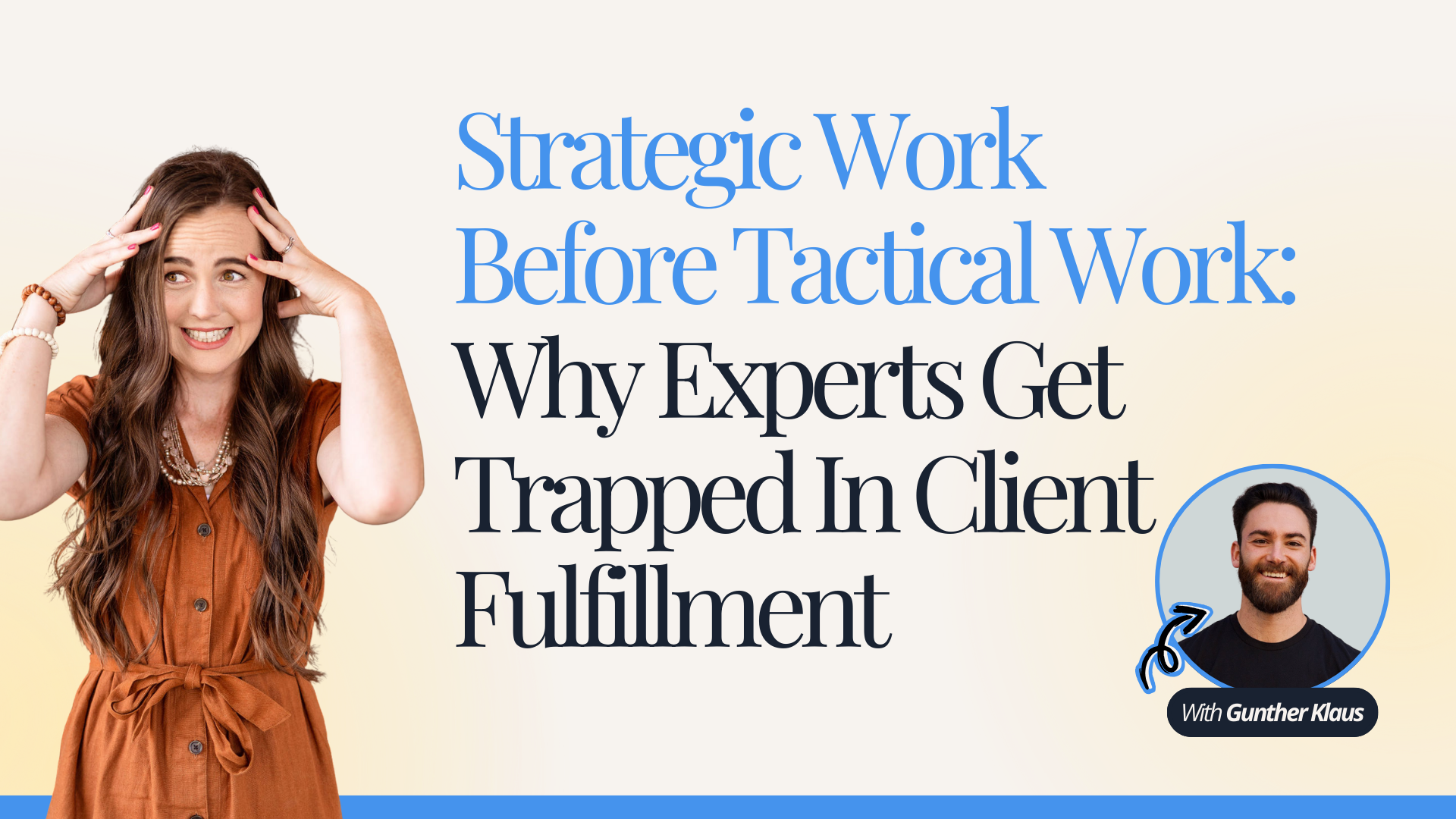
He turned his own struggles with pain and performance into a lifelong pursuit of biomechanics—and today, Gunther Klaus is the go-to specialist helping athletes and everyday people move, train, and live without limitations.
In this raw and honest conversation, Gunther opens up about the hidden challenges of turning deep expertise into a business, why overwhelm keeps so many entrepreneurs stuck, and how the mindset of an athlete can be the exact blueprint for entrepreneurial success.
Key Takeaways:
- The problem every expert faces—why your brain wants to explain everything you know and how to focus on what people actually want to hear instead
- The overwhelm trap that kills progress—why anxious entrepreneurs gravitate toward quick wins and easy tasks instead of the harder work that actually grows their business
- How to get comfortable with failing—the small steps approach that helps perfectionists learn to try things and improve instead of waiting years to get started
Connect With Gunther Klaus:
Instagram: @guntherklaus
Website: guntherklaus.com
YouTube: youtube.com/@CoachGuntherKlaus
_____________________________________
More ways Embodied Marketing can support you:
If you’re ready to hand off your entire marketing strategy (from funnels to ads to copy) and finally get the expert team you can trust, apply here and let’s talk: helpmystrategy.com
WANT TO WORK WITH TEAM EMBODIED MARKETING?
Honestly, we’re more than a marketing team — we’re a tactical partner who will care about your business growth just as much as YOU (maybe even more)!
We’re here to play the long game and help you create a powerful impact!
SUBSCRIBE & REVIEW THE PODCAST!
Thanks for tuning into this week’s episode of the Embodied Podcast! If this podcast has added value and helped you in your business journey, please head over to Apple Podcast, subscribe to the show, and leave us an honest review.
Your reviews and feedback will not only help us continue to deliver great, helpful content, but it will also help us reach even more amazing entrepreneurs just like you.
READ THE EPISODE TRANSCRIPT
Emily Hirsh: In today’s episode, I am joined by my friend Gunther Klaus.
Gunther Klaus: I am a biomechanic specialist nowadays, and I’ve always been in the world of fitness to some degree.
Emily Hirsh: We dove into his journey as an entrepreneur, an athlete talked about the biggest mistakes that he’s made, the biggest lessons.
Gunther Klaus: That whole marketing lens is just, that’s the last thing that my brain wants to do.
It’s okay. I’m gonna mess it up, and then I’m gonna do it again and make it better, and then I’m gonna do it again and make it better. If you make that decision, you can be convicted. But through my own like reflection, I see that after making that decision, I sort of forget that I made the decision.
Emily Hirsh: You are going to love this episode.
Embodied CEOs don’t chase trends. They pave the way. They lead from within. Move by purpose, unshaken by noise. When you are the source, you do not need permission. Hi, welcome to the podcast.
Gunther Klaus: Thank you. Thank you very much for having me. I’m
Emily Hirsh: so excited for this. Me too. I’m also excited to share our story of the first time that we hung out.
We can, we can have. Great. I wanna hear your perspective of this story more hike. Oh, it’s gonna be so fun.
Gunther Klaus: Yeah.
Emily Hirsh: Well, let’s start a little bit about, you tell us your story, your journey, wherever you feel relevant and called to start.
Gunther Klaus: Yeah, that’s a good question. I would say. My name is Gunther Klaus. I am a biomechanic specialist nowadays, and I’ve always been in the world of fitness to some degree.
Even as a kid, it’s just been sort of like an obsession and a passion. When you ask what my story is, I could go a million different routes, but I think the through line of my entire life has been essentially trying to. Figure out my problems, right? And my problems as a kid. Were not feeling powerful, feeling, you know, anesthetic, if you will.
And I just had a lot of pain and frustration as a kid around physical fitness and aesthetics and, and power really. This, I, I guess this is naturally coming up, so I, I’m gonna go with it, but my. I grew up with a stepdad who I just absolutely hated. And that dynamic between he and I was very verbally abusive, physically abusive, and that’s kind of where the whole power thing came into play.
I don’t even know if you, if you know this, so here you go for the first time I was actually ruminating on this a couple days ago and thinking about, you know, what led me here? And that’s been a big part of it. It’s been a big part of me kind of feeling I need to prove myself and attain more and do more and be more.
And there’s like little stories within the bigger story that have all culminated into, okay, I just need to be better, stronger, more capable better looking, all these things. So that was like my entry into fitness as far as like my desire for it to be a big part of my life. And in college I was on the division one rowing team at Oregon State University.
Before that, I was a big runner in high school. I was trying to run in college. And I say all this to say it’s athletics have been like a huge part of my life, especially endurance type sports. And of course I wasn’t big enough, wasn’t strong enough, so I was trying to body build at the same time. Got really into that world and I actually went into college with the idea that I was gonna get an exercise sports science degree and be a personal trainer.
My sophomore year, I was like, what am I doing? I’m gonna be a broke personal trainer. I switched my, I switched over to business information systems. And absolutely hated the rest of my college experience. But I thought, this is the way I gotta learn some coding. I gotta get into this and like make some money.
As soon as I was graduated, I came home and got a job as a personal trainer and I have not looked back since. I’ve been a personal trainer since a coach in CrossFit and now kind of a biomechanic specialist, namely, and specifically working with people in pain, helping them kind of navigate that journey.
’cause that’s been, you know, a part of mine. As well. There’s a lot in there. So sorry for kind of rambling on, but
Emily Hirsh: No, that was great. Yeah, I didn’t know some of those things. I love doing this ’cause I learned more about my friends. Yeah. Like, ’cause we never have this opportunity. So when you say biomechanics, we explain that for people
Gunther Klaus: For sure.
So I think this simplest way to talk about it is that your bones and your joints kind of dictate. All the usage of your muscles, right? So when people have problems, physical, chronic ailments, if you will, like chronic back pain, I wake up and I’m stiff. My elbow hurts when I try to do a bicep curl, these kinds of things, 99.9, if not a hundred percent of the time, it’s a leverage issue and things aren’t set up to be properly distributing force.
So you’re asking the body to do too much in one area and not enough in another. And so. This is just a higher level concept to simplify what is biomechanics and you know, what is it that I do as a specialist. It’s essentially taking a look at posture as a lens to begin to see where are you managing this?
Force production and leverage in the body well, and where do you need some help to restore some of these motions? And so I designed training programs that start with breath, work all the way to, you know, asymmetrical exercises. Think like you’re gonna do a split squat on one leg holding the bell in one hand and you’re not gonna do the other one because we need to like untwist and unwind and create space.
So we’re essentially restoring optimal movement through posture, breath, and exercise selection.
Emily Hirsh: And do you primarily work with athletes or like who’s your, right now, who’s your kind of ideal customer that you work with?
Gunther Klaus: Yeah, I’m, I’m searching for a term for who I work with because athletes. Conjures up, you know, professional athletes in sports, soccer, football, basketball.
I don’t really work with those people. I primarily work with the quote unquote athletes that are in the sport of fitness. So think CrossFit, high Rocks, everyday gym goers who just really want to get better. In any way, shape or form, stronger, faster, fitter. In general, the people who are obsessed with gonna the gym.
That’s my, my sweet spot. That’s, that’s my bread and butter. So me,
Emily Hirsh: so you, a hundred percent. Which we have. That’s a lot. Work together. I was like, please look at my snatch. Yes,
Gunther Klaus: yes. And I, I do work with people who are in like, no way, shape, or form, fit and need some help getting out of pain. A lot of people that I’ve worked with in the last few years on a, like a deep one-on-one.
Intimate level have been people who have been burnt by kind of the general system. They’ve gone to PT, chiros, Accu Acupuncture, all of the things, and not found any relief from their pains and ailments. And they’re usually being told that they need to have surgery. And something within, you know, this archetype of human is like, I, I want to just, what else can I do before I have to go in here and literally change the structure and put pins and needles and different stuff in my body?
Those people come to me and once we kind of go through the model, if you will, the higher level concepts of what I do, it’s pretty clear and obvious that, that that’s a possible path to success for them. And nine times outta 10 it is. And then there’s always that one outta 10 where I’m like, ah, shoot. You gotta
Emily Hirsh: go your surgery.
Surgery. Yeah.
Gunther Klaus: Yeah. Some things are just too far gone, right?
Emily Hirsh: Yeah. But you, you have the, like, you have the brain of detail. That I am always like, I need people like you
Gunther Klaus: and then I need
Emily Hirsh: you to give me the minimum amount of what I need to do. Yes. And we haven’t even gotten to catch up ’cause. He’s coming in short time, like we’re just doing this interview, but I, I don’t know if you’ve seen my Instagram.
I, I did hurt my back a little in CrossFit. Oh no. So I’m doing perfect. I’m here today. I’m doing the breathing and like all the things that, you know, Peter, my husband and Gunther could talk a lot about the same, you know, exercise science, that’s what I call it. I don’t know. But I need people like you.
So I also wanna tie that, I’m gonna get to tying that into business. ’cause I have a lot of clients who are like super experts in what they do, like you and then like bringing that into marketing and. I know that it can be a challenge, like when you have that depth of knowledge, then you have to talk to people who like don’t have that depth of knowledge and speak to what they want and their outcomes.
And I’ve supported you and I know your business, so I think that would be interesting to get into.
Gunther Klaus: Would love that.
Emily Hirsh: Yeah. Before we get into that, I’d love to know like. A lot of this, you didn’t end up going, you know, to college for that. You changed and then you got into personal training and then to, to have the level of expertise that you have.
There’s a lot of learning that has to happen. And I know because Peter has a different education, but very deep too, like years and years and years of like, I mean, you guys are better than doctors. I’ll say, you know, like,
Gunther Klaus: thank you.
Emily Hirsh: The level of detail of like, and what you can solve in the body is incredible.
How was that journey? Like how did you decide what path to go and like what was the right thing? And I know in fitness there’s a lot of like crap in like the traditional personal training. If you would’ve gone to school for that, I’m sure you wouldn’t even have used anything that you learned. And so what has that been like of deciding what your expertise was gonna be and what information you wanted to learn more of?
And I know you had a mentor that you learned a lot from. Yeah.
Gunther Klaus: Yeah. So again, stories within Stories within stories, but as a higher level concept here, it’s all been following my own pains, right? So coming out of D one, rowing and bodybuilding type stuff and going into CrossFit, I was beyond frustrated at the fact that I could deadlift.
Close to 500 pounds, but I could not snatch like 180 5. And I was just looking at my peers and thinking, how, how, how is this little guy who’s so much objectively weaker than I doing so much more and and better than me? And so, you know, that’s one story, that’s one example of a frustration where I thought, something’s messed up here, something’s wrong, kind of pushed me down the mobility path, if you will.
A lot of Kelly Starret, if you’ve ever heard of him, he’s like. You’re probably in the new age of CrossFit. He’s a dinosaur to you now. But yeah, it’s just like each phase of my own desire to attain a higher level of fitness and performance was met with some sort of block, right? A roadblock, a pain, a physical ailment an inability to do something that I wanted to do or thought I should be able to do.
And so each one of those occurrences led me down a different rabbit hole and I just. I’m fascinated by this and also really like determined to fix my own stuff. So I end up going deep and over time you just end up accumulating this wealth of knowledge and you find what works, you find what doesn’t when you go down one rabbit hole.
For me at least, it feels like upon reflection I kind of put blinders on. I’m like, this is the thing that’s gonna solve everything. So I go deep. And I don’t pay attention to anything else. And then something luckily takes my blinders off and I kind of jump to something else, and then I’m able to kind of cross pollinate, if you will, and take what’s good from one modality or you know, system and then leave what I don’t think serves and kind of blend them together.
The biomechanics thing came about probably four or five years ago. I saw a guy named Connor Harris online. Who’s a good friend of mine now, and he’s actually the one who first certified me as a biomechanic specialist and took me through this whole world, opened my eyes to, you know, everything that I do now.
And he had made some post about, you know, a hip pinch and I was like, oh yeah, I’ve actually dealt with that my entire life. And when he started talking about some motion within the pelvis, he, he used terms that I had never heard before through all of my schooling and all of my learning, and it really caught my attention.
And so I. Much like I think my clients experienced this moment of like, I’ve never heard that before. That sounds cool. I wanna go this way. And I just ate it all up. It was incredible. And it seemed like this knowledge or this information that I was learning in this course was filling all of the gaps that I had unknowingly created throughout all the rest of my journey of trying to find solutions.
So that. Is why I’m where I’m at. I don’t know if that answers your question fully.
Emily Hirsh: Do you, do you find that you like go too? Have you had times where you go too far down, like the learning and then you forget about the business side?
Gunther Klaus: Absolutely.
Emily Hirsh: Yeah. Peter does the same thing. It’s that like personality type and where I’m like, I’ll just focus on the business and do minimum learning and I’ll just mess it up as I go.
And then we
Gunther Klaus: need people like you so badly. Exactly.
Emily Hirsh: Yeah. So how have you, like, let’s talk about your entrepreneur journey a little bit in the lessons that you’ve had to learn, because did you set out saying, I wanted to be, you know, an entrepreneur, a business owner, when you started as a personal trainer, like what did you wanna do?
Where, where’d you see yourself, and then now you have your own business and it’s not just one-on-one clients. You’ve done programs and many things in the entrepreneur journey. How did that happen? And then also like what have you learned about yourself in that and kind of, you know, I, I feel like our greatest strength is our greatest weakness.
I say that all the time, like my weakness is that I move too fast and I skip things. You know? So there’s this balance and so that’s your greatest strength. That’s why you have such an incredible program and can do such incredible work with clients and make such an impact. And it can also show up as a weakness that you have to like offset.
So let’s talk about that.
Gunther Klaus: Yeah, I mean, that last part is. Easy because it’s very clear, easy to answer, because it’s very clear. My greatest strength and weakness is moving too slow and is going way too in depth and into the weeds and details. As an entrepreneur now, if you can even call me that, I feel like a solopreneur in the fitness space that’s you’re an entrepreneur.
I, I think that that is just glaringly obvious, my biggest weakness. I take a lot of time to take action on the things that I know. And then upon reflection, I’m like, I knew that for six years before I did anything about it. Right? Like literally six years, 7, 8, 9 years ago, I was talking about content and eyeballs and getting on camera and replicating what I did in the gym and the feedback that I got from my clients and, and even just athletes in, in the gym space, in the coaching space about how great I was at what I was doing.
I was like, well, I can just magnify the shit outta this online and, you know. Slowly, barely moving. Why? What comes
Emily Hirsh: up? Like, is it because you want it to be perfect or you like you’re, you’re overwhelmed by it? What stops you from taking that action?
Gunther Klaus: Depends on the timeframe. In the most recent past, it’s been time and it’s been my sort of inability to put the strategic work ahead of the tactical work, right?
To get caught up in, in. The fulfillment of serving my clients, messaging, programming, making sure things are good. It’s a little bit of blend of the perfection, but I, I don’t fully subscribe to that. Like, you know, that’s a common thing is, oh, it’s gotta be perfect. So nobody does anything ’cause they’re just tweaking, tweaking, tweaking.
I don’t really have that problem. I definitely can relate to that and have some of that, but I think it’s more about just, there are things that have to get done, period. For a new. Opportunity or a new offering to exist. Right? And it’s way easier to say, well, it does, it’s not due tomorrow. So like, I’ll, I’ll start on it tomorrow and then tomorrow becomes.
Next week and next month and next year and it doesn’t happen. That’s been my biggest struggle in the last probably year if, if I’m being honest. And that’s clear to me now because I’m shifting that and I’m actually like kind of working to rewire how I do this and I’m forcing myself to get strategic work done before I am allowed to touch.
And it feels so awful. I’m literally like about to swipe my tab back to my clients to text them and I’m like, no, don’t do it. Work on the project. So that’s. That’s answering the question on, you know, where has my, my, what’s my biggest struggle right now?
Emily Hirsh: I think a lot of people can relate to that. Do you think that it’s because you.
Like, you know, the client stuff so well that it feels so easy. It’s like that’s your flow state is is when you’re doing the programming, when you’re working with clients, talking with clients, and then the other stuff is like, I know like watching Peter, it’s like doing the mar, his brain just doesn’t work that way.
Mm-hmm. So doing like the marketing and the business development, it’s like so hard for him that he’d rather just work with the clients and do the client work. I’ll tell you the secret. You just hold yourself up to the deadline, like me and give yourself no choice. ’cause there’s a webinar tomorrow and you haven’t done the slides literally.
Right. And then you do it.
Gunther Klaus: Yeah, for sure. And that has worked for me as well in the recent past. And I’ve, I’ve done that and, but I, I do want to comment on,
Emily Hirsh: yeah. That
Gunther Klaus: aspect of, you know, is it a flow state and easier to get involved with the client stuff? And I would say no, it’s not at all. I actually. I actually do know what flow state is, and I do know what creativity is, and I do know what that feels like.
And it’s amazing. I think I’m constantly in an anxious state and I don’t like to put labels on things like this for myself, but I just, the best way to describe it’s, I think I’m, I constantly looking for quick task fulfillment that’s gonna help reduce my anxiety. I feel overwhelmed by all the things and it’s easy for me to just like check off quick little wins or quick little boxes that keep me.
Feeling like I’m accomplishing something, but really stuck in this loop of
Emily Hirsh: Right.
Gunther Klaus: You know, perpetuating the problem versus project
Emily Hirsh: that has like a hundred steps to be able to finish that project and you don’t even know all the steps and, yeah. Yeah,
Gunther Klaus: yeah. And then of course there’s this huge barrier to entry with anything around marketing.
And I would say my, one of my biggest struggles is with. What you said earlier, it’s simplifying all this crazy brainiac stuff because your brain
Emily Hirsh: doesn’t work that way naturally. It doesn’t.
Gunther Klaus: No. Like I want to go in depth and get into the brainiac stuff and when you ask me to talk about outcomes, and I don’t even know the terms, but just simplifying things to speak to someone who doesn’t understand what you’re saying.
Right. And get them excited about what it’s gonna give to them. That whole marketing lens is just. That’s the last thing that my brain wants to do.
Emily Hirsh: Yeah. And I think, I think there’s a lot of people that are gonna relate to this because I see this a lot in experts in their field. Like they love what they do, they love the work, they do the learning around it, and they’re so good.
I see that so much. Like, you’re so good. If people, if more people just knew and then that comes down, that’s my job. Right? Like the marketing and the messaging. But what has helped you as you’ve learned this. And don’t say like nothing to, don’t say like, I haven’t figured it out because I know you’ve worked on this.
So someone listening who’s like, oh my God, that’s me. Like I get into the details and I wanna go deep, and then I get overwhelmed. And also you’re in a phase where you don’t have a team. And I think that makes a huge difference. Like ideally, you surround yourself with people who offset. The weaknesses, right?
Like, so I surround myself with people good at operations and the details because I know that I’m not, but it adds to the overwhelm when you are having to do, wear all the hats and do all the things. But over the last, you know, couple years, what have you found has helped you in making the progress?
Gunther Klaus: Yeah.
Well I would say right now, ’cause this is so present for me and I feel I, I do feel like I’m making leaps and bounds of progress like within the last few months. One is surrounding myself with more of those people that can support and offset my weaknesses. And I’ve used money as a limitation on why I can’t have a team for forever.
And I just kind of watched Nikki, my wife, go through and quote unquote manifest these things for free so many times. Right. And it’s, it’s opened up my eyes to the possibility that things don’t have to be this direct monetary trade. Right? So for example. I’ve got some great friends who are stellar ex experts in their respective fields, and I just started kind of having conversations with them about, you know, what do you do?
Like getting into their world and understanding them. And just recently I’ve sort of come into relationships with people who can help me with these aspects of my business and, and find ways to trade without having to spend dollars. That doesn’t feel like a sustainable thing. And there’s always, you know, muddiness when it comes to trading, right?
Expertises. But that’s been really helpful in this with regards to specifically getting the support for other people. And then what I talked about with this strategic work before tactical, making that rule for myself of I have to complete X amount of strategic work before I go tactical. And what’s been really helping me is putting a timeframe on it rather than an outcome of achievement.
So instead of saying I have to get this, you know, email sequence done before I can touch the tactical stuff that I wanna knee jerk go to, I’m like, I have to sit here and do this for an hour. And I don’t really care if I get one email done or eight. And what ends up happening is it reduces the pressure and I get eight done and I’m really happy about it.
Yeah. ’cause
Emily Hirsh: you don’t feel like, oh, I have to get eight emails and that feels so overwhelming. Right. It’s like I’m gonna work on it for this period of time.
Gunther Klaus: Absolutely. So that’s been helping a ton.
Emily Hirsh: That’s good.
Gunther Klaus: Yeah.
Emily Hirsh: I feel like, yeah, there’s just so many. I think overwhelm is just such a block for a lot of entrepreneurs, especially when you don’t have the support in the team.
I mean, honestly, everyone’s overwhelmed. I mean, let’s not the labels, but everyone’s full, full in life.
Gunther Klaus: We’re all trying to full more than we can and figure out, figure out where to
Emily Hirsh: put your time. And there, and with business, it’s not black and white. Like here’s your, you know, you don’t have a boss handing you like.
Here’s your task list for the day. You have to constantly be figuring out what’s gonna move the needle the most, what’s, ’cause there’s never a shortage of things to actually be doing. And it’s like then the decision’s on you of what is that thing and then am I working on the things I should or the ones I wanna be doing?
And you know, is the decision making too. And I know you’ve gone through iterations of your offer and like your business model and like having to make those decisions can also cause. Overwhelmed. ’cause you’re the only one making them
Gunther Klaus: a hundred percent.
Emily Hirsh: Yeah. But having people to bounce stuff off of is huge.
I mean, perspective, right?
Gunther Klaus: Yeah.
Emily Hirsh: I think a lot of it comes down to that, like getting the perspective and then getting the perspective and then coming back to, okay, let me check in with myself. As the final. I talk about that on here because I think also you can get into where you get so much perspective, it creates more noise, and then you’re like, well, this person who has this really successful business said this, so I should do it this way.
But it’s not really what’s in alignment with, let’s say, your expertise or your strengths or your vision, and then you end up going down the path and it doesn’t work. Yeah,
Gunther Klaus: a hundred percent. I, and I’ve had that many, many times conflicting, suggestions, suggestions from people that I greatly admire that don’t feel aligned and like screech tires when I hear it right.
But I kind of ignore that and try to, okay, I have to do this thing. And it just prolongs the neglect of self, right? And, and something too. This is so silly, but just so true. I have found that chat, GPT has been the greatest ally for me in this. Realm of basically just the psychological, like overwhelm style or type of issues where one, I know some of the things it’s gonna spit out are, I mean, it’s like a people pleaser.
It’s it’s an echo chamber. It’s, there’s a lot that you have to kind of be careful of or cognizant of. But one thing that I find really, really helpful is I know if I am having this kind of back and forth with chat, it is unbiased to some degree. It’s gonna kind of pull out and, and get me to reflect myself so it feels like I’m having this therapy session or coaching session with someone that I, you know, respect and, and admire and appreciate.
Not to say that I do for chat, but just the same way you would for someone you respect, admire, and appreciate. But it’s not gonna get me to a place where I’m like, oh, I have to do this thing that they said. ’cause they said to do it. If chat gives me a response that I don’t like, it’s easy to just be like, no, no,
Emily Hirsh: that’s not it.
Yeah, you suck. Yeah,
Gunther Klaus: you suck next. Right. And I’ve actually been spending a lot of time in there and trying to find ways to use my skills as a coach to then coach myself. So one thing you said about the overwhelm, it’s like, well, I, I help people change their habits often. Right. It’s not like the thing I do, I work with athletes who are already committed to the gym most often, but.
When you’re trying to make some drastic change, you can’t go a hundred percent. I’m gonna be the person I want to be 10 years from now today. Right. It’s like you gotta get these, you have to build momentum. Right? And usually that comes faster by going easier and just stepping in, right?
Emily Hirsh: Yeah. Attainable.
Gunther Klaus: So this is my greatest strength.
That is my greatest weakness, is like I know how to go slow. I know how to not. Go into the gym and do a thousand pull-ups, day one and never do ’em again because I’m wrecked, right? I know how to kind of appropriately dose that and overload it and get progression over time. And so I’ve been using that for myself, and this is again, where that whole get the strategic work done first comes into play.
I’m like, I can do 30 minutes to an hour of this every day. Like this isn’t overwhelming. I’m not trying to be Gunther 10 years from now today. I’m just trying to make sure that he exists 10 years from now by doing little things today.
Emily Hirsh: Yeah, very methodical. Mm-hmm. Chat’s also really good at simplifying.
So you can put like, here’s my, you know, brain dump of all of the very complicated things. And it is great at simplifying things down or pulling out marketing language, especially when you feed it, like the good stuff that you have. The depth, I think where people are gonna struggle is they don’t have the depth that you have and then they go try to use chat for their marketing and they’re not actually, you know, good at what they do.
And so it’s like, then it comes out as the surface level, but when you have the depth. A true expert, you know, leader has chat’s. Great. Like, I mean, I wish I had this, I wish I had it 10 years ago. Like imagine. Yeah. You know, now it does. It is helpful for that specific thing. Mm-hmm. Yeah. What would you say is like some of your biggest lessons that you’ve learned or mistakes that you would wanna share on your, on the entrepreneur journey?
Gunther Klaus: Well. I feel like I’m still wrestling with this lesson, but moving faster is definitely one that I would like to improve upon, and it’s something that I know needs to be addressed. I’m a, I’m a big proponent of people leading into their innate strengths and talents and not trying to be someone they’re not.
Emily Hirsh: Right. Same. Yep.
Gunther Klaus: But I also know that just from a conceptual standpoint, if I were to. Take action quicker on things and have the understanding that iteration is a part of the process. I’d be a lot further along, right? Instead of waiting for the iterative thing that I’m happy with before I let it be known and existing in the world, go with something that I know is within the right like trajectory, even when it feels like meh.
Be okay with having to iterate over and over. At least that’s what I’ve seen from all the successful entrepreneurs that I admire most. They just are like, I don’t know. I’m gonna show up and we’re gonna figure it out.
Emily Hirsh: It’s for sure. Yeah,
Gunther Klaus: and it seems to work so beautifully and I’ve never been able to find that.
Emily Hirsh: Yeah, it, I mean it, I think it’s like it is something you naturally have or you gotta teach it. You gotta force yourself, I think to do it, it’s the do it messy. Just build the plane while you fly mentality. I feel like there’s a lot of crossover athletes to entrepreneurs. What would you say is the correlation there of like, like do you do that in, ’cause we haven’t talked about it, but you are an incredible athlete, you’re like top at High Rocks.
Mm-hmm. Do you do that in training or is everything really methodical or is there the like figure it out kind of mentality that happens?
Gunther Klaus: Yeah, that’s a great question. And. Funny because I, I, I do feel so strongly that in the realm of fitness, I show up in the best way possible. I have both a blend of very detailed, methodical, intentional program plan, a foresight, you know, preparation.
And I also have a healthy dose of fuck around and find out. Yeah. And I’m okay with that. And I think that comes from confidence in doing it so much. And also just.
Emily Hirsh: Trusting yourself.
Gunther Klaus: That’s the biggest pillar. That’s what exactly what I was gonna say is I trust myself, right. I trust myself to navigate that.
Emily Hirsh: So in business, you need to figure out how can you trust yourself
Gunther Klaus: 100%. And if we tie it to what I said about action, I don’t trust myself. Because if I, in past, if I look back and and, and am honest about what I’ve done, if I put out something that I’m not happy with, it doesn’t go well. It kind of puts me in this like.
Nah, it wasn’t right. I don’t want to do it again, and so therefore, I, I don’t have the iterative process, right? It’s like, if, if this is making sense, it’s, it is totally. It’s the entrepreneurs who are like, it’s okay. I’m gonna mess it up and then I’m gonna do it again and make it better, and then I’m gonna do it again and make it better if I mess it up.
It just hits too many weird things within me, deep in my psyche and, you know, triggers, if you will, that I’m like. The, the stove burned me and I’m never gonna cook again. And so I’m, I’m working on that now. Yeah. And trying to expose myself to that, to be comfortable with it and know that things are, I’m gonna go back into this and again, another thing that I’ve noticed recently is if I take these steps of slowly building momentum, it’s a lot more manageable.
Emily Hirsh: Well, ’cause you’re kind of giving yourself a little bits of confidence
Gunther Klaus: right?
Emily Hirsh: As you do that, I think. Yeah.
Gunther Klaus: So I’m, I’m intentionally trying to rewire that in the sense of like, rewire always sounded so frustrating and annoying to me. What I mean by this is rewire it through actions. So to like literally build deep trust in myself, but through micro exposures or baby steps of like, okay, I said I was gonna do this thing and it didn’t go well and it’s not.
A six year project that is so overwhelming that I’m not gonna do it again. It’s like this tiny little workshop that I hosted and I’m like, yeah, I’ll do that again. I will do that again. And so just kind of learning to trust myself by micro, micro occurrences or experiences of trusting myself doing what I say I’ll do.
Emily Hirsh: Yeah, and I think, I mean, we have similar like. Personal development beliefs and the way we look at the brain and stuff. And I, I think it’s something like with the, the belief that you have it in your, how you see yourself, like you see yourself as obviously an athlete, a really good athlete, a top athlete, and that’s where the trust comes from.
But you even said like, I wouldn’t call myself an entrepreneur on here. I think you don’t see yourself as the entrepreneur that you are already. And so then. You’re like, oh, well I couldn’t make that decision right, because I’m not, not really an entrepreneur. So that, and it’s like overnight you can’t be like, well you can’t, you can’t actually overnight say, I am gonna, you know, believe that I am an entrepreneur.
But I feel like there, if you could tap into that energy of what would happen if you’re just like, I’m a seven figure entrepreneur. Just for from now on. Yeah. Like I’m gonna show up that way.
Gunther Klaus: Yeah. And that is the starting point. But I think the missing link or the missing piece there is that you, and I’m speaking from experience here, if you make that decision, you can be convicted.
But upon through my own like reflection, I see that after making that decision, I sort of forget that I made the decision and then I’m left with all this evidence to say. What happened to that whole decision, dude, see, you’re not an entrepreneur. Yeah. And so it’s the, it’s being able to remind yourself or again, have those micro exposures to then build that new frame of, or new perspective on self over time.
Yeah. And again, I’m speaking from like, I haven’t done this yet. I’m do. I’m in it. I’m in it now and I’m doing it now. And I do feel like it is, it’s happening. It’s gonna happen. I have always deeply believed like I’m going to be a successful entrepreneur. Period. The end. It’s, it’s happening. But it definitely felt like, okay, but when,
Emily Hirsh: but what if you already are right?
Gunther Klaus: Sure. And I, I welcome this, right? Absolutely.
Emily Hirsh: I mean, what success, you haven’t worked a job in how many years. You’ve got flexibility with your family and son. You’ve traveled in the summer. What’s success? A money amount. Yeah. But you’ve also had. Good months of, of money and honestly like you also, you could have way more clients, but you, you don’t wanna do just the, a bunch of one-on-one.
You have a vision for it. Mm-hmm. So what’s success? What if you already are successful?
Gunther Klaus: Yeah, I could reframe it and I could tell you a million ways that I’m extremely successful. More than most people for sure. Yep. There’s one that I focus on so much, which is the monetary aspect. And in that it kind of.
Blankets, everything else. Mm-hmm. I’m so focused on it.
Emily Hirsh: Yeah. And I think, I mean, I get it, right? It’s like the money is the scorecard. Yeah. But you’ve had to go through a lot of learnings through experience to be able to figure out offerings, business model, how you wanna scale. Because at least the last time we talked, you didn’t wanna have like unlimited one-on-one clients.
Yeah. And I think you could have more if you wanted
Gunther Klaus: for sure. Sure.
Emily Hirsh: Because you’re so good, but you’re like, I want these. Programs or, you know, a more scalable way basically to deliver, which takes the iterations.
Gunther Klaus: Yeah, for sure. The, the thing about one-on-one is, I love it, but it, at the end of the day, it, every one-on-one client feels somewhat akin to like a child of mine, right?
Like I care about their results so much that it’s really taxing. And if. I’m working, I’m, I’m working primarily with people in pain. And you know, when you get those messages about like, oh, this flared up today and this doesn’t feel good. It’s like this huge hit Yeah. To the heart of like, oh man. And then it becomes this fire that you have to put out and trying to respond really quick.
And I say have to, I’m aware that I don’t have to, right. There’s a whole, there’s a whole reprograming reprogramming of perspective on my responsibility for someone’s outcomes in that. But, i’ve just experienced, you know, having 30 one-on-one clients at a time and being like, this is my whole life, is just in this constant looping of worry about each individual person.
It feels like you have 30 kids.
Emily Hirsh: Yeah. It’s lot. It’s just too much. Yeah. Especially with all on your own of, of managing that and the communication and all those pieces. Yeah,
Gunther Klaus: so I’m pretty relentlessly focused on being able to deliver that value and that. Solution for more people without the direct intimate touch to me, right?
Putting the power in their hands, helping them understand what I know to kind of do it themselves. And this is an awesome, you know of course my struggle is that I’m unable to, or have been unable to simplify the death. But that is kind of my life’s work now, is how do I simplify all this unnecessary minutiae knowledge so that anyone can kind of plug and play what I do for themselves.
Emily Hirsh: Yeah. Which is challenging because it’s, it is deep and and technical, what you do and what you teach.
Gunther Klaus: Mm-hmm.
Emily Hirsh: And there’s a lot of people who don’t want to know that, but they just want the. That’s me. Just tell me the, tell me the breathing thing I have to do. Yeah. To fix my snack for
Gunther Klaus: sure. But, and then I would argue the other way around is like, you think you don’t wanna know it, but if you were able to know it in a way that was easily, like if I could just upload it to you would say yes.
Right? Yeah. You would like to know what is going on, why you’re doing this thing, so that you can have the power to do it on your own. Right. True. I mean, how wonderful would it be to have your back issue, whatever it is, and know how to solve it and know why you are doing whatever you’re doing and being able to recall that experience or whatever it is.
And that’s a part of your tool bag then. I mean, that’s huge. That’s empowering you to not be reliant on someone else to fix your physical problems.
Emily Hirsh: Yeah, you’re right. And for me. As with like a lot of humans, that took me getting hurt and then it’s like now you have to figure it out. Always, you know? Yeah.
Forced to, and you’re right, I do. I actually am really fascinated by it, but I, it’s, for me, that’s overwhelming because like when I talk to Peter or you, Peter will drive me crazy. Like, it’s like, okay, this is what I’m feeling. And he’s like, well, it could be this, or it could be this, or it could be this. And I’m like.
That’s zero help. Like totally. I need, I need to know exactly what it is. But he is like, but it doesn’t work that way. Like, we have to do this analysis. So that’s where I get overwhelmed. It’s actually not that I don’t wanna know it, it’s that I’m like, it’s not, it’s not logical and black and white enough for me.
It’s too much nuances. Right,
Gunther Klaus: right. A hundred percent. So that is my, that is my job, right? Is that’s, that’s this next iteration and that’s how I’m going to be able to affect change with. Multiple thousands of people rather than just tens is being able to get past this. This is my new block, right? This is my new roadblock that I need to figure out how to get around or move, which is simplifying these concepts so that you don’t have to go through this process of Peter.
That doesn’t help me. What’s happening? Yeah. Right, because I, I know that there’s a way to do it, because I can do it myself. Right. And just because it took me 10 years of deep focus every single day doesn’t mean that I can’t convey the concept or the information to you in a simplified manner.
Emily Hirsh: Yeah.
And I mean, that’s, that’s taking your wisdom, your experience of actual experience, your knowledge, and creating your own method. Your own process. Yeah. Which you probably already have is just defining it, right. Explaining it. And I’m in
Gunther Klaus: that right now.
Emily Hirsh: Yeah. It’s
Gunther Klaus: very fun.
Emily Hirsh: I mean, but it also continued to evolve.
Yes. Forever. A hundred percent your process. ’cause as you get it out there and then people start using it, you’ll find ways. I’m still like redoing one of our programs right now and finding ways to make it more simple. Mm-hmm. Make it more clear. Mm-hmm.
Gunther Klaus: It’s
Emily Hirsh: like years of in the making on the lessons and the mistakes.
So go faster. Any others come to mind that you would share?
Gunther Klaus: I don’t know. I think I’d have to dig deeper into. I’d have to conjure up some other thoughts. Yes. About what I’ve done and, and what I’ve learned. I guess one thing that comes up right now is following the passion primarily has always been a positive outcome. If I look back on all the things I’ve done, if all of the things that I’ve gone or led to the most success have come from. Like real desires of mine to create or, or just do. Right. So when I first started my entrepreneurial journey, I was frustrated that I couldn’t take on any more one-on-one clients in person.
I couldn’t charge any more than I was charging. I was charging a lot in LA and I had, you know, I was training like CEOs that I can’t say ’cause I literally signed NDAs and like people that. Everyone knows,
Emily Hirsh: and he thinks he’s not successful, booked out with high level CEOs charging a ton in la come on. And
Gunther Klaus: I didn’t have time to do my own laundry.
And it was driving me nuts. And I thought, this is not enough money. This is not, you know, I don’t have any more hours. How do I, how do I make this more profitable? And that wasn’t the, the root of. How do I do something different? But it was a frustration point in my, you know, in my head, in the back of my head.
And that was coupled with this desire to, again, like I am now, help more people. And so I created this class in the CrossFit space where I essentially took. All the people who came to my classes all the time, who wanted to work with me one-on-one, but one I did not have any spots. Two, they probably didn’t wanna pay the price that I was charging.
I was like, well, what if I just get, you know, eight of you in here at the same time? And we do a group. Programming that’s individualized. So I’m still gonna work on every one of your individual needs, but we’re gonna get to do all the things that you don’t do in CrossFit that you need to do as someone who wants to get better at CrossFit.
And I called that strength in mechanics and it was the coolest thing I think I’ve ever created to this day. Can you do that
Emily Hirsh: in Austin? ’cause I would go to, I would love
Gunther Klaus: to. And honestly, right before the pandemic started, I was like, I need to teach every other coach in the CrossFit world how to do this.
Because everyone can, and this is like the most. Amazing thing ever. I mean, I could go on and on about how I still have passion around it. I’m still trying to figure out how I can make this become a thing. And what I’ve learned as an expert, like in the biomechanics world, has been after the fact. I, I didn’t start that journey until.
Mid pandemic. So now what I know, coupled with what I was doing before, I mean, I could make this so much better than it was. But yeah, just following that passion and just going forward with that is definitely a big lesson of mine.
Emily Hirsh: Yeah. I think that sometimes people get lost with that and they, they start to say, oh, I’m not having the success I wanted yet, and so now I’m gonna listen to somebody else.
I’m gonna do what they say. I’m gonna get away from my passion. And it is so important, like what you love and what comes easy to you. And even when you’re talking about that, I can tell that that’s something that you love and feel lit up about. And I just, yeah. I can’t emphasize enough for entrepreneurs like, follow that.
Gunther Klaus: Yeah.
Emily Hirsh: Because people like that. That’s the secret that nobody teaches is like, they’ll teach you how they did it and their method and their template and their business, but it’s like, but that’s infused every single time with their passion and your gifts. I think what natural, what naturally comes easy to you, set your business up to leverage that instead of fight against it.
Gunther Klaus: Yeah. Yeah. Making me feel some way right now thinking about it. The, the part that you asked about, you know, with fitness and being able, and I, and I said that I feel I blend those two aspects of structure and insight and a, you know, a plan with the fuck around and find out those. Those don’t feel true for me when it comes to business yet.
And I’d love to get to the place where I’m leading, I’m leading the, the direction of the ship through the excitement and passion, and then finding the way to structure it and refine it and make it better. I’ll just get specific for a sec, if you don’t mind. I, with this endeavor. It’s not something that I’ve seen anyone else necessarily do before.
That doesn’t mean that nobody’s done it before, but for me, that feels like uncharted, scary territory with a lot of risk. And so it almost feels irresponsible to say, I’m gonna go forth in this direction with no plan, with no structure, but I’m just following the passion. And this is again, why I wanna rework this and, and lean more into the ability to just put myself in an, in an arena and figure it out.
Right.
Emily Hirsh: My question would be, what’s the risk
Gunther Klaus: time wasted,
Emily Hirsh: but is it ever really wasted? I
Gunther Klaus: mean, I think the main, for me, the main fear, if you will, is the time that income does not come in.
Emily Hirsh: Yeah. But there’s probably a way to say, I’m gonna make sure I have at least this met with my one-to-one clients. While I simultaneously do this and then get rid of the thought around, it’s a waste of time.
’cause it’s never a waste of time. Because those things, even, even if it doesn’t work, it’s like that led to the next thing. And without doing that, then you wouldn’t be able to do this. Like, that’s the power and failure
Gunther Klaus: easy for someone who’s innately inclined towards action. Easy. I know, but I’m,
Emily Hirsh: yeah, but I’m telling you like you’ve gotta, you’ve gotta almost like.
Try to fail, I think.
Gunther Klaus: Yeah.
Emily Hirsh: Yeah. Is where you need, you need to be like where every day you’re like, my goal is to fail a hundred percent.
Gunther Klaus: I know, and I’ve talked about that specifically too. It’s like when it comes to the gym, that is literally the guiding light. You’re like looking to find your edge and failure,
Emily Hirsh: right.
To see where, ’cause that’s where your growth is. And I’m,
Gunther Klaus: I’m like addicted to it. And it doesn’t become this like, Ooh, I got burned by the stove. I couldn’t do one more rep. It’s like that’s my,
Emily Hirsh: I think it’s because you trust yourself in the gym
Gunther Klaus: 1000%.
Emily Hirsh: And so how do you build trust?
Gunther Klaus: Micro exposures, I think.
Yeah.
Emily Hirsh: And and showing your, yeah. Showing yourself like, okay, I failed, and then I know what I’m, I’m gonna do this. Yeah. And building that.
Gunther Klaus: Yeah.
Emily Hirsh: Every day. Like what would you say to someone in the gym? It’s like, you gotta do it every day.
Gunther Klaus: Yeah.
Emily Hirsh: In tiny ways. Absolutely. Right? Every single day. Consistency of it.
Not from like one big project that fails, but like the everyday things.
Gunther Klaus: Yeah. It’s playing within that arena, or appreciating and respecting the principle of it. The principle of, of failing every day rather than I gotta go do this massive thing and then just becomes this one.
Emily Hirsh: Because then, you know, and I, I think the journey is the goal, not the finish line.
Right. And it’s, and I think that a lot about trading too. Like I have gotten to a place where like, yeah, I wanna win competitions. I don’t even have an expectation of going to even the age group games. Like I don’t, I don’t need to go that far. I appreciate the process so much. Like if I can just show up every day and give it my all, then I won.
Gunther Klaus: Yeah, yeah.
Emily Hirsh: Right. It’s like same in business. If, if you can just show up every day and be intentional with that, Dave, like, this is what, what I feel is the most strategic thing for me to do, and then follow through with it. It becomes an identity, I think
Gunther Klaus: for sure over time, for sure. And that is the quote unquote secret of progress, which is you are not, just as you said, you are not tied to the outcome of making it to the even age, age group games.
If you were, you’d probably be far less fit than you are now because you would not be showing up for the day for the process.
Emily Hirsh: Right. Yeah, you gotta make it about the journey. I, I say that a lot to entrepreneurs, like, especially in the realm of content creation and showing up. It’s like, it’s not about I need this many followers, or I need to make this much money.
Even. I think the money is a byproduct of all those little actions, you know? And so if you make all the little actions, the goal. The money and the sales follows and, and you probably don’t even know the exact path of how it’s gonna happen.
Gunther Klaus: Mm-hmm.
Emily Hirsh: You can’t right now. Like you’ve got this big number goal.
Same. It’s like, I’ve got, I’m gonna get to eight figures, how I don’t even know. Mm-hmm. All the steps, right. Because there’s gonna be things and opportunities and shifts and changes that happen along the way that I don’t even know about yet.
Gunther Klaus: Yeah.
Emily Hirsh: So it’s just, what’s the next step? The daily things that are gonna move the needle now.
Mm-hmm. It does come natural to me. Yeah. And I’m lucky for that. And and there’s a weakness to it too, for sure. Yeah. But I think, I think it can be learned
Gunther Klaus: for sure
Emily Hirsh: every day.
Gunther Klaus: Yeah. Yeah.
Emily Hirsh: And you have so much correlation of like athlete to entrepreneur and there is so much there that I think if you take that strength of, of an athlete, you like bridge the correlation of like what it would mean.
You could train yourself
Gunther Klaus: for sure to
Emily Hirsh: be an athlete entrepreneur. Yeah.
Gunther Klaus: A hundred percent. Yeah.
Emily Hirsh: This was so good. I wanna tell the story of how we met. I just think it’s so fun. Okay. So Gunther and I met at a business event like four years ago, maybe. We lived, both lived in Austin, but we didn’t know each other before.
And it was in Montana, in Whitefish, Montana. And I was staying an extra day to go on a hike by myself. And I love hiking. And I’m like, I’m going on a big hike. And everybody at the event was like, oh, can I come with you? And I was telling everyone no, because I’m like, no, listen, I’m going on like. A 14 mile hike and I hike fast.
So I was telling everybody, no. I mean there was like older people asking me whatever I was judging, and I’m like, no. So the Gunther comes up to me and he is like, listen, I’m an athlete. Can I come with you? On this hike tomorrow. I promise I can keep up. And so I’m like, yeah, you can come. Which was probably a good decision ’cause Grizzlies in Glacier National Park.
So Gunther and I barely know each other. I pick him up in this Jeep I rented at like 6:00 AM at the hotel we drive two hours into through Glacier National Park. Like beautiful. My memories of it are just like, I was just there again and I thought of the hike. I mean, it was just like a core memory.
Gorgeous sunrise fog on the river. Like the whole time we’re like, holy shit, this is so pretty. We go on this hike, it was like 14 miles. Elevation. He obviously keeps up. He’s faster than me, but it was just such an adventure and that was the start of our friendship. And then we came back and Nick, he, your wife was on the podcast, but she, you know, we became friends.
But I dropped you right off at the airport too. We hiked all day. We saw moose like it was the fall. I mean, it was so beautiful the whole time. We were. Freaking out. We did see Grizzly, but at the end of the hike, far away. Not like my last experience in Glacier. Yeah. And I dropped you right off at the airport.
I was like, all right, we’re best used now. It
Gunther Klaus: was such a commitment. So, so much faith in that process or maybe just naivete and ignorance we’re like, yeah, sure, let’s do this. Because
Emily Hirsh: like without knowing your personality too, what a great like. Talk about like not having the plan.
Gunther Klaus: Yeah, absolutely. I’m
Emily Hirsh: pretty sure we got lost
Gunther Klaus: on that
Emily Hirsh: road when?
When a moose ran out in front of us. Oh, we did? Yes,
Gunther Klaus: I remember that now.
Emily Hirsh: We drove on that grass
Gunther Klaus: and that moose was the biggest moose I’ve ever seen.
Emily Hirsh: So you just went into my world of like, we’re gonna figure this out.
Gunther Klaus: Oh, it was great. That was such a fun day, and it was the perfect weather and the perfect time of year, everything was just bright.
Oh, the fall colors, bright colors. Yeah, and I was terrified in the beginning and also like, how the hell was this girl gonna do this by herself? We’re like at that lake in the beginning, and this girl has a gun on her hip and bear spray on her shoulder. Then I see another girl walk up with a gun. I’m like.
Emily, they all have guns.
Emily Hirsh: I think you just recently told, but maybe it was Peter, you’re like, I knew it was serious when I saw a guy with two guns.
Gunther Klaus: Yes.
Emily Hirsh: On the trail, which now I get after going back to Glacier and having that encounter with a grizzly, it’s no joke. And I was gonna do that all by myself.
No service. Early in the morning, we didn’t see a lot of people. We saw a few, but we didn’t see a lot. We saw two. I mean, we were there early until the end. Yeah, until the end. Oh man. Now having this conversation and like our personalities just, what a great. We’ve been friends since. Yeah,
Gunther Klaus: it’s been great.
I’m really glad that I kind of forced my way into your hike that day. I was like, look, your excuse about me not keeping up isn’t gonna hold. So
Emily Hirsh: you are like, I’m going with you. Try
Gunther Klaus: to draw a boundary another way or I’m coming with you.
Emily Hirsh: That was, it was awesome. And I dropped you right at the airport. You barely made your flight.
’cause we went to the wrong airport. That was my
Gunther Klaus: fault. I felt so bad about that. I’m like, yeah, this is the airport. It’s fine.
Emily Hirsh: And we drove like five hours that day total. Mm-hmm. When you added it all up, probably
Gunther Klaus: more.
Emily Hirsh: Through the Indian Oh
Gunther Klaus: yeah.
Emily Hirsh: Reservation. We’re like, should we get out here to the bathroom?
Super sketch. It was,
Gunther Klaus: yeah. Every part of that day was awesome.
Emily Hirsh: It was it like, I go back there, I can’t not remember that day. ’cause it was just one of those like, just like light your soul on fire because it was just adventure and fun. Just beautiful nature. Yeah. So fun. That’s great. Anything else you feel like we didn’t touch on today?
Gunther Klaus: No, I don’t think so. I don’t know what we need to touch on.
Emily Hirsh: Anything on your mind? If, if you feel like
Gunther Klaus: No, it’s great. Love it.
Emily Hirsh: Yeah. Thank you so much. Where should everyone go to follow you and consume more of your content, which I highly recommend you should make more content ’cause your videos are very good.
Thank you.
Gunther Klaus: Yeah, we’re leaning in right now Instagram if you have it. Gunther Klaus is my handle. And I think Coach Gunther Klaus on YouTube that will start being a source of good content as well. And then my name, guntherklaus.com.
Emily Hirsh: We’ll link to all of it. I hope you create that content, just imperfect action.
Yeah. I’m gonna hold you accountable to that. Thank you. Thank you so much.
Gunther Klaus: Yeah, thank you. It’s been great.