
→ Stop spinning your wheels and build a strategy that consistently brings traffic, leads, and sales to your business. Embodied Marketing Live is coming up: https://get.embodiedmarketing.com/live
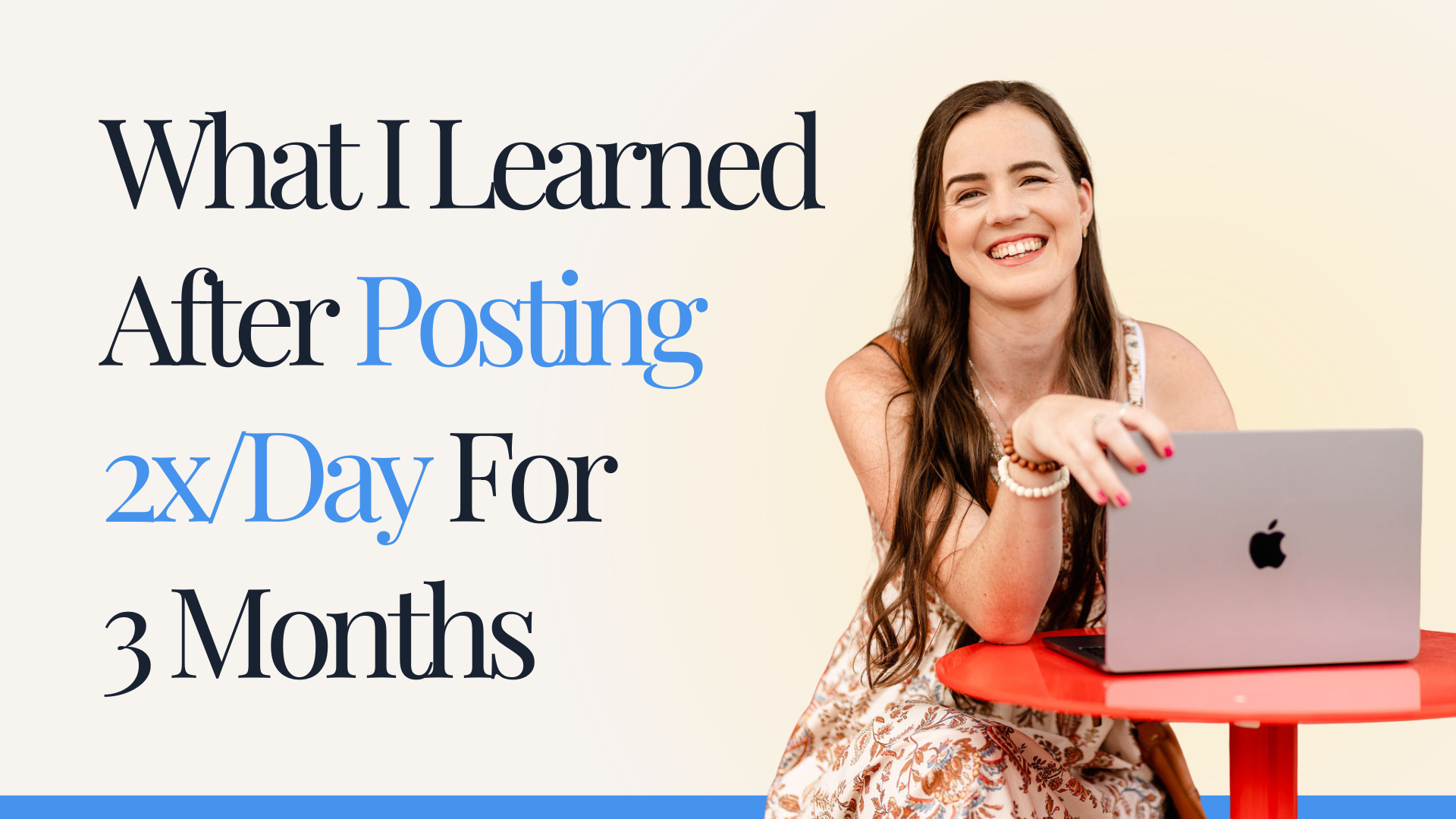
I used to be kind of anti-organic content. But over the last three months, I’ve created more than 180 pieces of content, and it’s completely changed the way I think about it.
In this episode, I share what’s worked, what hasn’t, and why I’m investing in content more than ever… even though I don’t expect it to be the thing that grows my business.
Key Takeaways
- Why I completely changed my mind about organic content
- The unexpected lesson from publishing 180 pieces of content
- What finally clicked after months of creating content almost every day
_______________________________________
More ways Embodied Marketing can support you:
Turn your expertise into consistent revenue. Funnels, strategy, launches—everything done for YOU. Apply here: https://get.embodiedmarketing.com/app
WANT TO WORK WITH TEAM EMBODIED MARKETING?
Honestly, we’re more than a marketing team — we’re a tactical partner who will care about your business growth just as much as YOU (maybe even more)!
We’re here to play the long game and help you create a powerful impact!
SUBSCRIBE & REVIEW THE PODCAST!
Thanks for tuning into this week’s episode of the Embodied Podcast! If this podcast has added value and helped you in your business journey, please head over to Apple Podcast, subscribe to the show, and leave us an honest review.
Your reviews and feedback will not only help us continue to deliver great, helpful content, but it will also help us reach even more amazing entrepreneurs just like you.
READ THE EPISODE TRANSCRIPT
Emily Hirsh:
You need to have the infrastructure and the systems in place beyond content to grow your business. A lot of times in marketing, people like to blame the mechanism. You have to trust and know that it is in the ecosystem of your marketing, and it’s helping move the needle in multiple ways. And I do think it will grow your business in terms of followers and reach, but it’s not the main driver. You gotta be a master. And I’m gonna do it no matter what. I’m gonna show up even if I don’t want to. And even if it’s not the best video in the world, I’m still showing up.
Embodied CEOs don’t chase trends. They pave the way they lead from within. Move by purpose, unshaken by noise. When you are the source, you do not need permission.
Hello and welcome back to the podcast. I hope you guys are having an amazing week, and we are officially, when this comes out, in July, which feels wild. The year is halfway over. And also, I feel really great about this year. I feel like I went into this year very focused on only a few things, and that felt really good and really worked, and we have really created a lot of momentum from those few things.
So I actually wanna talk about one of those, which going into the year, one of my focuses, number one focuses, was content and media. And I talked about it, I’ve talked about it a lot on the podcast, how I went… I saw Cody Sanchez speak, and Dan Martell, and between those two, I was like, “I need to up my content game.”
So I went into this year with the vision of getting a full-time content person in Austin, getting my office, the studio, the new place and posting two times a day. And so I thought that today I would share a little bit of just the takeaways of that. So since the beginning of April, and we’re now in July, I’ve basically posted twice a day, six days a week, so 12 pieces of content a week primary focus being Instagram.
We put it on Facebook, but the primary focus is Instagram. And just kinda wanted to talk to what I’ve learned, what’s worked, what we’ve changed, what we’ve shifted around, and am I gonna keep doing it? So first of all background on that is I… And I’ve talked about this a lot, so I won’t go into this too deep, but I really saw the long game benefit of media and content and kinda changed my mind about it because I used to be anti-organic content, which is, the saying, “You reserve the right to change your mind anytime,” is very true.
Because sometimes you’re shown something from somebody else and you realize maybe you weren’t right about that and maybe, you wanna change your mind. So I saw the benefit of media and content and being consistent with it when I went to Cody Sanchez’s head- headquarters, when I heard Dan Martell speak, which was about a year ago, and realized that not for the short-term business growth, but for the long-term impact that I wanna have- Creating content at that level was gonna help me get there.
And so I wanted to invest in that from a consistency play, knowing that it wasn’t gonna be an immediate return. And so I think a handful of podcast episodes ago, I talked about the short-term, immediate return marketing strategy that we run, which is my weekly live webinar, and then how I have the long-term kind of slow burn investment that I know is gonna pay off in the years to come.
And that is how I see content. I do think that the organic content, I’m sure it assists in sales, right? Because I do run ads, and I get a lot of followers from those ads. I also get followers from the organic content. but I think having something when you get the followers, and now you have all these posts, and you have this way of creating that connection can be a positive thing.
It’s very hard to track the direct ROI from organic social because like you can’t track, oh, they saw that organic post and then they become, became a sale. Or maybe they saw an ad and they came to the webinar, they saw three or four organic posts, and those helped convince them to become a sale.
You have to trust and know that it is in the ecosystem of your marketing, and it’s helping move the needle in multiple ways, most likely. So anyways, that’s important that I say this over and over again because I do think that people make the mistake of thinking That organic content and posting organic content is going to grow their business.
And I do think it will grow your business in terms of followers and reach, but it’s not the main driver. It’s not the engine behind your marketing strategy. It’s a visibility tactic. It is a game of time and consistency because the algorithm, you don’t get to choose who sees your post, how many people see it.
It i- that can be a frustrating slow part to the game, which is why the consistency is so important. You need to have the infrastructure and the systems in place beyond content to grow your business, which looks like the lead gen, the live launches, the funnels, and ideally paid ads for reach.
That I think is the best case scenario. Speaking of that, so I’m hosting for the first time, it’s probably been six months since I’ve done this challenge, maybe longer. I’m hosting the Ultimate Facebook Ads Challenge again. This is like the most popular experience that I host, where we actually together launch an ad in three days.
So we launch you a visibility ad that can reach thousands of ideal customers in a matter of a few days. And that’s how you take a piece of content and you actually put that in front of the exact right audience. So I’m finally hosting it again. It will be on July 14, 15, 16. So if you go to embodymarketing.com/challenge, you can save your spot for that.
It is the most popular free experience that I put on because we actually have trainings on how to set up the ads from my team, so it has that tactical component to it, as well as teaching kind of this strategy. Anyways, so I really think you need that in conjunction with content. I was at a point in my business where I was like, “For the long term, I wanna invest in this.
I wanna invest in the content growth.” I also wanna do it as a challenge for me to get better at creating content, which is what I’m gonna talk about today of what we’ve learned. So we’ve posted a lot of content two times a day since the beginning of April. And just so you know the process, ’cause I think that helps people understand, ’cause you can repeat this process probably not with a full-time person.
I think that for a lot of you guys, two times a day is probably not a good idea, right? You have to weigh what would that take away from. So for me, the only way that I knew I was gonna create that much content is if someone else was helping me come up with all the ideas, record it with me, edit it, post it.
So literally all I do is two hours a week of social media content recording. That does not include my podcast, so my podcast is separate. Two hours a week, we meet in person, about two hours, and she comes with all the ideas that we are gonna record, which she pulls from a mix of… I’ll get into that, but she pulls from a mix of trends, a mix of ideas that we’ve found from other industries and other things online specific, topics and angles for face-to-camera videos.
We do a variety. So my actual time investment has been two hours a week, and that’s all I have to do, is show up and be told what to do. And we’ve built a relationship where I, she knows and I tell her “I want to just be told what to do. Just direct me. I want to show up to my office. You’re like, ‘Here’s our list.’
You tell me what to do, and we record.” And so that is the flow that we have. So she shows up. She does quite a lot of work on the development of the content, on what we’re going to record. There’s a lot of… I think probably the most amount of work goes into that research, goes into looking at what we’re recording, like the angles, the way that we’ll take a trend and spin it so that it’s our right ideal customer, will be attracted to it.
So upfront, her and I did a lot of work of I… marketing 101. Who’s the ideal customer? What’s their pain? What’s their frustration? Where are they at right now in their business journey? What are they… what do they want? What’s my offer? So I went really deep with her on that for the first several weeks.
We did a lot of talking, and that’s also something that we do in the two hours. I’d say probably, like- I’m a machine when it comes to recording content, I will say that. I can get through a lot of videos in an hour. So a good portion of our time is actually also talking, where I start riffing and I start saying, “Oh yeah, this thing happened or this happened,” and really trying to brain dump on her where m- where my ideas are and things and experiences in my life or the business or takeaways, like real time, can be translated into the organic content.
So in our two hours a week together, I would say half of that time is strategizing. And not just strategizing, but talking and I’m communicating ideas or thoughts or takeaways and things like that in my own voice that she’s gonna translate into content. Or she’ll interview me sometimes for a carousel post and ask me things.
But that is o- only because I can do, We can probably get 20 pieces of content done in an hour right now, so we’re able to get through a lot. So that’s the flow. That’s the flow that I have with someone and how much time I’m investing, which I knew was the only way that I was gonna do this.
I definitely am not coming up with the ideas and have that capacity and needed my team to do that. Then in terms of what has worked and what I’ve learned it’s been really interesting. So first of all, of course, the more that you post, the more quality of the content, your account’s gonna grow.
My account has grown a significant amount in terms of followers in terms of engagement. Every single number is up 100% after we, we did that. And we have learned a lot around what content works and what doesn’t, and it’s interesting. So in, in my experience, we do a variety all the time.
Every week, we do a variety of some face to camera videos, carousels lots of B-rolls and trends. What works the best on my account in terms of engagement is the trends and is the more funny, We’ve done some funny role-playing team ones. So those work the best. The- In terms of engagement, those work the best.
Those get the most likes, those get the most engagement and just overall reach on the account my face to camera videos don’t always get the highest engagement, but they usually get the most new followers. So that’s an interesting thing because you have to look at the different metrics of not just likes and engagement and reach, but also followers and profile clicks and, are they, is it a more quality person because they watched the face to camera?
So the face to camera videos, we’ve really worked on getting those numbers up. And I’d say that’s actually where I had to improve the most. I want you guys to know I went into this like the way that I think anyone should go into really anything with their marketing, but especially content, is I w- am pretty unattached to the metrics.
Obviously, I want to see that it’s working. I’m investing in this a good amount. I’m investing in content. I see it as an expense right now of the long game. I know it’s helping sales. I know it’s helping our overall business, and my business has been growing pretty much all year, which is really awesome.
Yeah, all year. And then the weekly webinar has helped a lot with that. But I do think the content plays a part. It’s just hard to attribute exactly how much it has played a part. But also, I’ve gone into this with I don’t care about the likes on my posts. I don’t hide the number of likes ’cause I feel bad if one gets 10.
I don’t care. So I have really detached anything around my own worth and my ability to create good content and any of it from that. I really don’t care. And I don’t… I will have posts that get nine likes, and sometimes there are ones that I’m like, “This is so good, and it’s so funny,” and then it gets nine likes.
And a lot of times it’s actually not because the engagement was low, it’s because the reach was low. So for whatever reason, the algorithm just didn’t push it out. That’s usually what happens so… when we have a low performer. So I w- have gone into that very much like this, and I think that’s really important because it, it can be frustrating.
If you are really attached to an outcome and you’re attached to how you want the result to be and you’re, like, really upset when you don’t get engagement and you don’t get the likes you’re gonna end up being upset and disappointed. And I look at it, like when I look at people who get, viral posts, and they get 20,000 followers from a post and whatnot, I’m like they’re just on a better level than me.
That’s how I look at it, and I’m fine with that. I’m getting there. I’m putting in the reps to get there. I think that there are some people who are way better at creating content than me ’cause they’ve created more of it. And so one thing I’ve learned in this is creating a face-to-camera video on social media today is very different than recording my podcast.
And I’m really good at recording podcasts. I’ve recorded 800-plus episodes. I’m really good at webinars. I’m really good at ad videos. The direction that organic social media has gone, that I’ve realized, is very organic, very off the cuff, very natural. But I’m off the cuff, and I riff, and I feel like I’m organic, but here’s an example.
The face to camera videos that do better, I have to actually have had to teach myself how to not talk like this. Like, when you’re making these face to camera yapping videos, you actually have to have a lower tone, and as if you’re just talking to your friend, right? And when you’re talking to your friend, you’re talking more like this, of da.
And you’re not talking as, You know what I mean? On the podcast I’m more emphat- emphatic, I think. And so I’ve actually had to train myself how to do these videos differently, because they do better when I really make them as if I’m talking to a friend and not recording a video. Which, I don’t know if there is a difference, and there, it is different than recording this podcast.
And I would say that I still have improvement. I’m still, my Haley will come and she’ll be like, “Okay, re-say that, ’cause you said it too much emphasis.” Or another thing I’ll do is I will talk a little bit in a loop. I’ll repeat myself, but not in a negative way repeat myself. I’m bringing home the lesson, and I’m breaking it down like a boom.
And it’s because I have done that on the podcast for so many years. It’s how I have taught content. But face to camera social videos are just different. The other piece to them is the hook. I had to get really good at doing hooks, and actually, I would say I am somebody who doesn’t like scripts. I hate scripts in my videos.
If I have to… If you tell me a line to remember, you’ll tell me it, and I’ll go to record it, and I forget it. I just, my brain doesn’t work that way. I can riff, but if I have to think about it really hard, I forget it. However, our face-to-camera social videos are not scripted per se, like line by line at all.
but the hook is planned, and then the talking points are planned. And I’m allowed to, riff on the talking points, and then we trim it. But it is more intentional than even my podcast because the podcast is a little bit longer piece of content, so I can riff, and I can, repeat a little bit and teach and go in these circles, and that’s a different type of content than a social video that’s a minute.
And you have to capture someone in the first few seconds, and then you have to keep them, and you have to get a point across, but it can’t be too long. There just has to be more intention and more planning that goes into that. And so when I first started making face-to-camera videos, I think I was like, “Don’t script them for me.
I’m really good at this. I’ll just riff.” And not like they’re bad videos, but they didn’t perform as well. So now we have them planned a lot more. She plans them. And the actual hook, the first thing I say, she’ll give me like three options, and I’ll choose one, and I say it almost line by line. So it’s actually scripted and planned.
Then we have talking points, and I riff on those, and then we edit it and trim it up. But I’ll say what I’ve learned in terms of a hook Is I would go into a story too soon. So I would start talking about the what instead of hooking somebody in that first line. So for example, I had this video where I was talking about my shoulder injury.
And I was turning it into a lesson of whatever. It happened for a reason, I learned from it. And I started the video by saying, “Six, four months ago, I tore my labrum in my shoulder,” right? That’s not a good hook. You don’t start with the story. A better hook would have been, “I haven’t been able to do a pull-up in six months, and here’s why I’m okay with that.”
‘Cause then you’re like, “Why hasn’t she been able to do a pull-up?” Instead of just starting with the story. So that’s something that I’ve had to learn how to do. I would say that I am way better at doing hooks than I was four months ago. And so I wanna share this too, ’cause I want you guys to understand, I have had my podcast for eight years.
I have created social content for that long. I have done hundreds of webinars. I would consider myself a pretty good content creator, and I’m still getting better at it. And I’m still… I look, I could look back at the content we started in April to now, and it’s better. And not just me Haley too.
The editing, we’re figuring it out. We are learning what works, and that is the way marketing works, regardless of the level you’re at. And then you just keep taking it to the next level. And so when I look at Cody and I look at Dan Martell and I look at the Hermosis, I’m just like, first of all, they have a huge content team, but second of all, they’re at a different level.
Okay, how did they get to that level? They put the reps in. They have created the thousands and thousands of pieces of content that has earned them that level. If I wanna even come close to that level, I gotta put the reps in. And you gotta start wherever you’re at. And you have to do it in a way where you understand I’m doing the best that I can with what I know how to do today.
And then when something doesn’t work, w- you know, without being mean to yourself, you’re just like if I get better, it’ll get better.” When I have a video and it’s it didn’t do well, I don’t blame the algorithm. I don’t say like Organic social media sucks, and it, I wish that stupid Instagram would just show my video to more people.
I’m like I didn’t make a good enough video.” And it’s not like I’m mad at myself, it’s just like I’ll do better. I’ll learn from it. I’ll learn from how to make better hooks. And when I see people, crush their content and get all these views, it’s like they’re making better v- videos than me.
They know how to do their hooks better. They have probably been favored in the algorithm because of that. So my point being, a lot of times, too, in marketing, people like to blame the mechanism or blame something else and be like, “Oh, it just sucks. Facebook sucks,” or, “Instagram sucks. Organic reach sucks.” And it’s it’s possible to be successful at any of these things, but you gotta get good enough.
You gotta be a master. You gotta be a master at it. And do you want to do that? So back to kinda what I’ve learned. For us, the trends, the funny, humorous content does the best. The face-to-camera videos, though, although they don’t perform the best in terms of engagement, they’re getting better.
We’re getting better at them. But they do perform the highest quality. They create the most connection. And then carousels also do pretty well for us, especially when we can make them pretty organic and nail a connection. So one of the top ones we did was, like, things that I’m failing at as a seven-figure entrepreneur, or things that irrationally make me mad or something was another one we did.
So things like that do really well. So we will continue to do these two times a day, continue to get better. And if I was to summarize to bring it into what I believe you guys can implement, it’s number one, get clear on your capacity for content creation. What does that look like in terms of your capacity and also your resource capacity in supporting you?
And then where does it fit in your priorities? Because it is a time investment, and it is a slow burn, meaning it’s not going to get you sales this month most likely. Like again, you need the engine behind the content to get you the sales. You’ve gotta have the funnel. It’s a source of traffic, sure, but even my, my webinar and different places that we want traffic from it’s not primarily coming from organic.
It’s coming from ads and then my email list. So be really clear on that so that… ’cause a lot of people, they, I think they find themselves in I just need to post more mode and I’m not posting enough. And it’s like, all right, what’s your goal based on where you’re at in your business and what’s priority right now?
What’s your goal? What’s gonna move the needle for you? And be super clear on that. And then challenge yourself and look at, I really believe, look at content creation like it’s working out Like it’s doing a workout. It’s like, how many times a week am I gonna do this? And how many pieces of content?
And I’m gonna do it no matter what. I’m gonna show up even if I don’t want to. I’m going to put my gym clothes on and go to the gym, and even if it’s a shitty workout, at least I showed up. Same with content. I’m committing to the amount that I’m gonna show up, and even if it’s not the best video in the world, I’m still showing up.
And I’m learning through the process of doing. And then detach yourself from the outcome. If you don’t put the pressure on content to be a number one growth driver, and you don’t care about the likes… I literally don’t care. I obviously want my content to do well, and I take the feedback as data, but I’m not ashamed if one of my posts gets nine likes.
I don’t care, right? And I actually like showing you guys that because it’s look, I have 24,000 followers and this post got nine likes, and I’m still leaving it up. I’m not deleting it, so detach yourself from that. Definitely detach your worth from that. And challenge yourself to put in the reps and to get better at it, ’cause it will make everything better.
I do think for me, the more content I create and then get feedback around what worked, it helps me understand what people respond to, which impacts my podcasts and my messaging and all the things that we do in our marketing. But you have to be realistic with what’s priority and what makes sense right now versus just throw yourself into something and way over-commit yourself, which I see people do that a lot with content, is it’s just like it’s never enough feeling, and I’m spinning my wheels.
And then learn how to get better at creating specifically social content, ’cause it is different. It’s different than ads. It’s different than a podcast. There is an art to those videos. That’s what I’ve realized. It’s not… the good ones… sometimes someone records ones I’m sure that’s off the cuff, wasn’t scripted, and it goes viral, sure But good quality where you’re teaching or you’re trying to draw people in, especially talking head videos, yapping videos on social media, they are an art.
And they are more intentional than you realize. And once you get into it, you realize how intentional people usually are with them. And so that’s been something I’ve shifted. So two things. Definitely join our challenge because if you do create content or you are creating content, I’m gonna show you how to take that content and turn it into a small ad.
Small priced ad. So embodiedmarketing.com/challenge. Second thing is, when this episode comes out, it’ll be about 30 days until our live event. And I forgot to mention this, but I have a guest expert coming who is an incredible content creator. She lives in Austin. She came to our last event. And we’re gonna actually live work on content with you.
So have you come up with a hook and a script and get live feedback on that at the event. And so a lot of what I’m gonna do at this Embodied Marketing Live is gonna be around your messaging, is going to be around content creation and that brand presence. So we do have some tickets still for sale.
If you go to embodiedmarketing.com/live, you can get your ticket to join me in Austin. We’re gonna do a lot of interactive things. And then on day three, the VIP day, is actually some done-for-you content creation. My team will be there. my content girl Haley is gonna be there. And so we will be able to speak to a lot more content ’cause I feel like I have flexed my muscle when it comes to content creation a lot over the last several months.
And so now I can teach it even better because I’m in the arena doing the work. All right, guys. Hopefully, I see you in the challenge, and hopefully I see you at Embodied Marketing Live. Thanks so much for tuning in, and I will talk to you next week